How often to water tomato plants
Sep 16, 2026 · 7 min read
In the ground: 1 to 2 inches a week, in 2 soakings. In pots: every day in summer. How to check, when to water, and what irregular watering costs you.
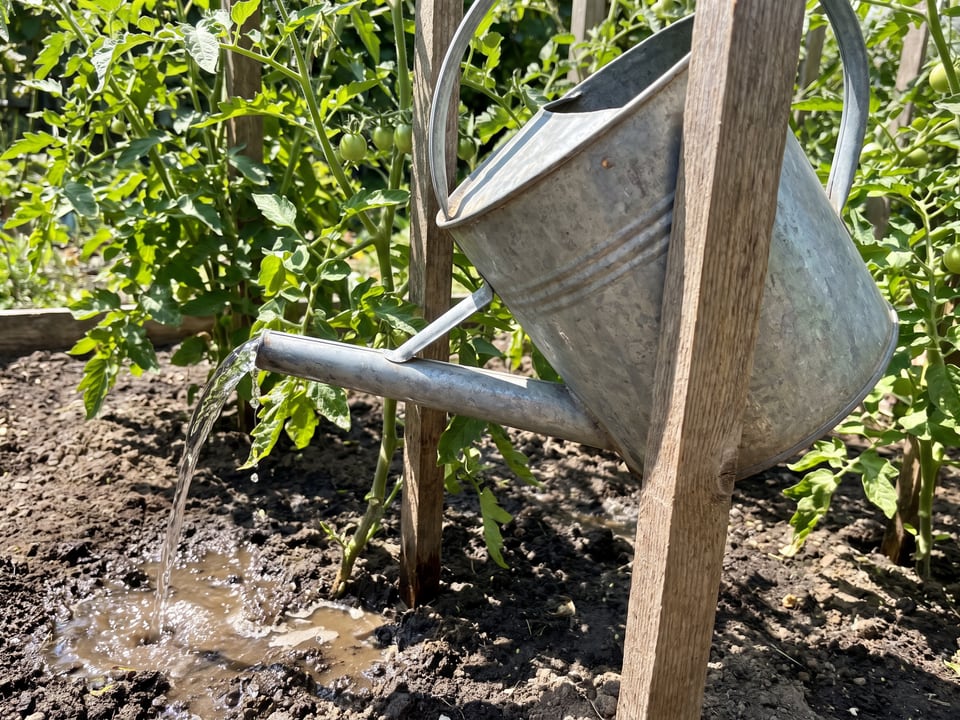
A tomato in the ground wants 1 to 2 inches (25 to 50 mm) of water a week, delivered in one or two deep soakings rather than a daily sprinkle. A tomato in a pot is a different plant entirely: in midsummer it needs water every day, sometimes twice.
The frequency matters less than the pattern. Tomatoes handle being a bit dry and they handle being well watered. What they do not handle is swinging between the two, and most of the fruit problems people blame on soil or feed start there.
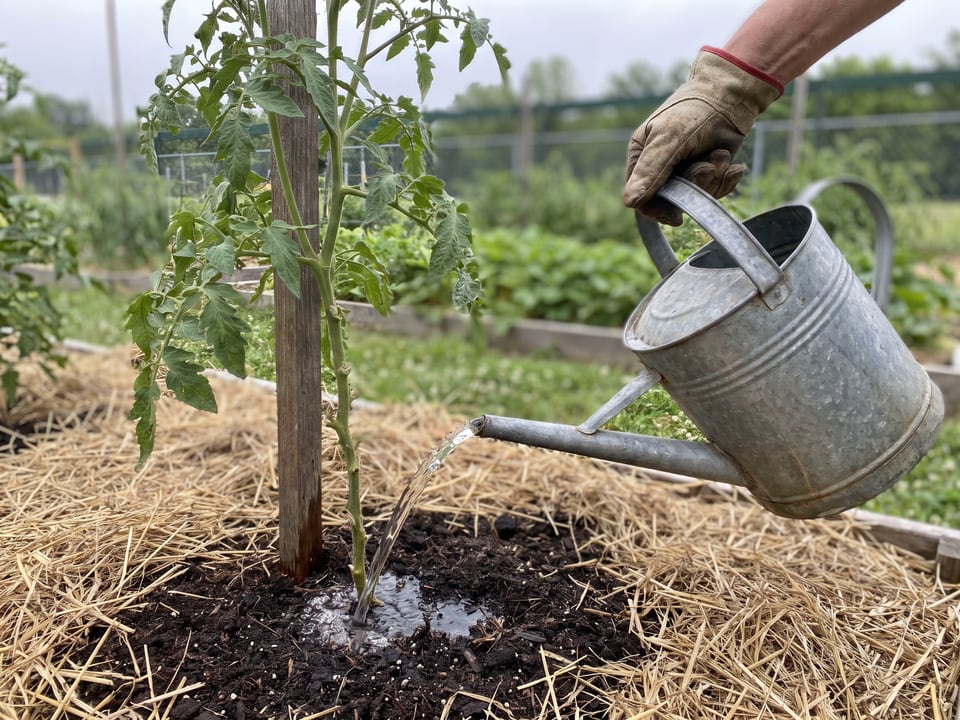
How much water a tomato plant actually needs
Utah State gives 1 to 2 inches of water a week, and Minnesota Extension calls one inch of rain or irrigation a week ideal, with the soil soaked thoroughly each time rather than watered lightly.
Three things move those numbers: temperature, wind, and how much leaf the plant is carrying.
Soil type moves them too. Minnesota Extension notes that an inch of water wets sandy soil to about 10 inches and heavy clay to about 6, and that very sandy soil may need watering more often.
How to tell without guessing
The trowel test. Minnesota Extension’s check is to dig with a trowel and see how far down the soil is wet; if it is only an inch or two, keep watering. This is more reliable than any surface appearance, because the surface can look dry when the root zone is not.
The pot lift. For containers, lift the pot, or tip it slightly. A pot that needs water is dramatically lighter than the same pot an hour after watering. Two or three tries and you will know the difference by feel.
What wilting does and does not mean. A tomato that wilts at 2 pm in full sun and recovers by evening is not short of water; it is throttling back transpiration. The same plant still wilted at 8 am is short of water, or its roots have a problem no amount of watering will fix.
When to water, and where
Morning. The plant uses it through the day, and any water that reached the leaves dries before nightfall. Utah State advises against overhead watering late in the day, because leaf diseases are promoted by cool, wet conditions.
At the base, not over the top. Minnesota Extension warns that soil splashed onto the leaves can carry disease spores, and that wet leaves are more disease prone. Point the water at the ground.
Slowly. A hose opened full runs off the surface and down the side of a pot without wetting the root zone. In a container, water until it runs from the drainage holes, wait a minute, do it again.
Why regularity matters more than volume
Two of the most searched tomato problems are both irregularity in disguise.
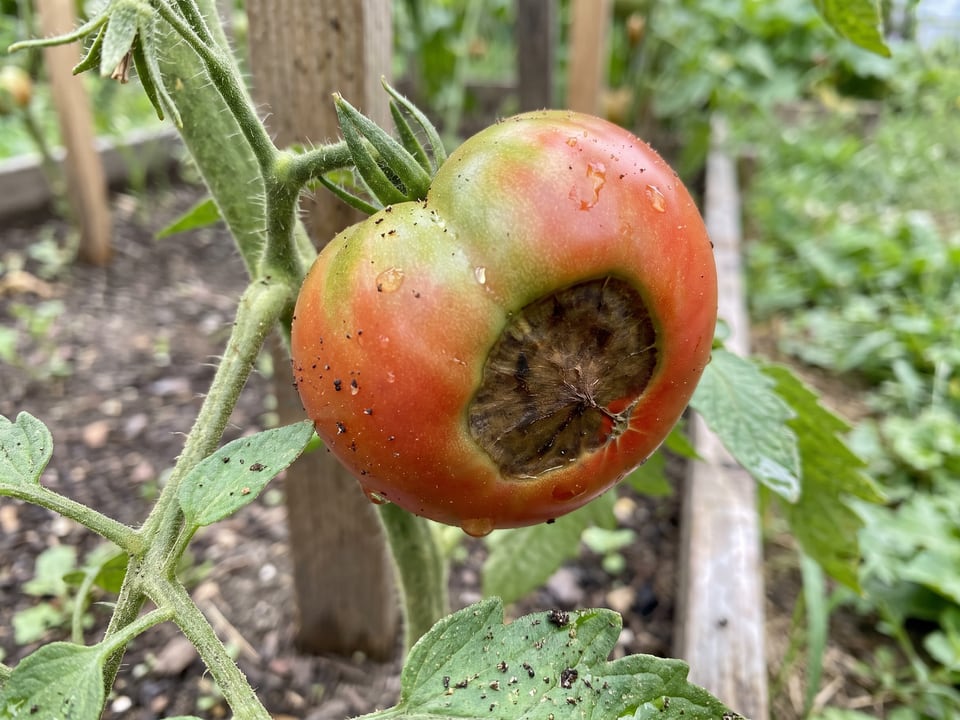
Blossom end rot, the sunken dark patch on the bottom of a fruit, is a calcium delivery failure. Utah State traces it to poor water management, excessive nitrogen, root pruning and drought stress, and recommends uniform soil moisture and a mulch. The feeding guide covers the calcium and nitrogen side.
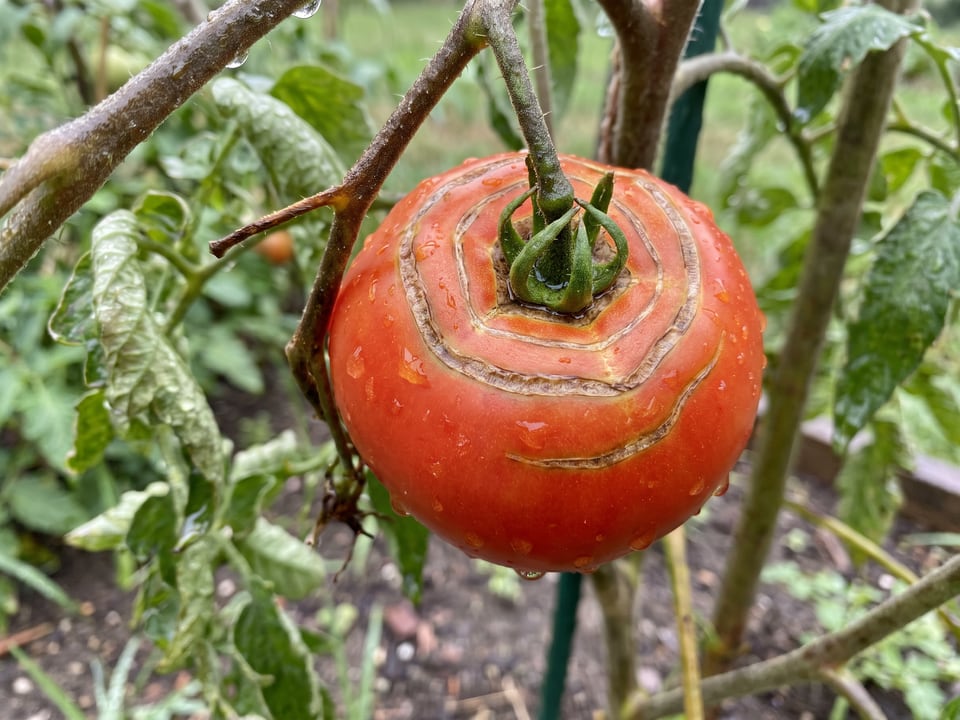
Cracking is the same fault from the other direction: a plant that has been dry gets a heavy watering or a thunderstorm, the fruit takes up water faster than its skin can stretch, and the skin splits. Concentric rings around the shoulders, or radial splits from the stem.
Some varieties resist it better than others. In our catalog Five Star Grape and Purple Zebra carry a documented crack tolerance in their resistance codes, and Utah State notes that many newer hybrids are quite resistant to cracking. None of them is immune to a week of drought followed by 2 inches of rain.
Mulch, which is the cheapest fix on this page
Three to four inches (8 to 10 cm) of straw, shredded leaves, grass clippings or bark over the root zone does three jobs at once: it slows evaporation, it keeps soil temperature steadier, and it stops rain and irrigation splashing soil-borne spores up onto the lower leaves.
Put organic mulch down once the soil has warmed; Utah State waits until it is above 75°F (24°C). Keep it an inch clear of the stem.
Drip irrigation and timers
A drip line or soaker hose along the row is the most reliable way to get regular watering, because it removes the person from the loop. It waters at soil level, keeps leaves dry, and loses far less to evaporation than a sprinkler.
The mistake is setting a timer in May and never touching it. A schedule that suits a newly transplanted seedling is a fraction of what the same plant needs in July, and a schedule that suits July drowns the plant in a wet September. Adjust it monthly, and turn it off when it rains.
Reading the plant
| What you see | Where on the plant | Usually means |
|---|---|---|
| Wilting in afternoon sun, recovered by evening | Whole plant | Normal heat response, not thirst |
| Wilting in the morning | Whole plant | Genuinely dry, or root damage |
| Lower leaves yellowing, soil stays wet | Bottom of the plant | Overwatering or poor drainage |
| Leaves curling upward and inward, firm and green | Upper half | Heat and water stress; usually cosmetic |
| Sunken dark patch on fruit bottoms | Fruit | Irregular watering, not soil calcium |
| Split skin after rain | Ripe fruit | Dry spell followed by a soaking |
| Whole plant wilts and does not recover, stem base dark | Base | Disease, not watering. Water more and it gets worse |
That last row is worth taking seriously: the reflex when a plant wilts is to water it, and for a wilt disease or a rotted stem base, watering is not the cure. If the soil is damp and the plant is wilted, stop and look at the stem. Yellow leaves on tomato plants works through the rest of the diagnosis.
Containers, briefly
Everything above changes in a pot. There is no reserve: the plant lives on what is in the container.
Water daily from the point the plant is taller than its pot, in the morning, until it runs out the bottom. Add a saucer during a heat wave and take it away afterwards, because a pot standing in water all season rots roots. A bigger pot is the real fix, and the pots guide has the sizes by growth habit.
What this comes down to
Water deeply, twice a week, in the morning, at the base, and mulch. Check with a finger rather than a calendar. In pots, every day, no exceptions in summer.
Nothing here needs a gadget or a schedule you have to maintain. It needs the same amount of water arriving at roughly the same interval, which is the one thing the plant cannot arrange for itself.
Sources: University of Minnesota Extension, Utah State University Extension.