How to grow tomatoes from seed: a sowing calendar
Sep 16, 2026 · 8 min read
Start tomato seeds 6 to 8 weeks before your last frost, in 75 to 85°F soil. The full calendar from sowing to transplant, with the numbers at each step.
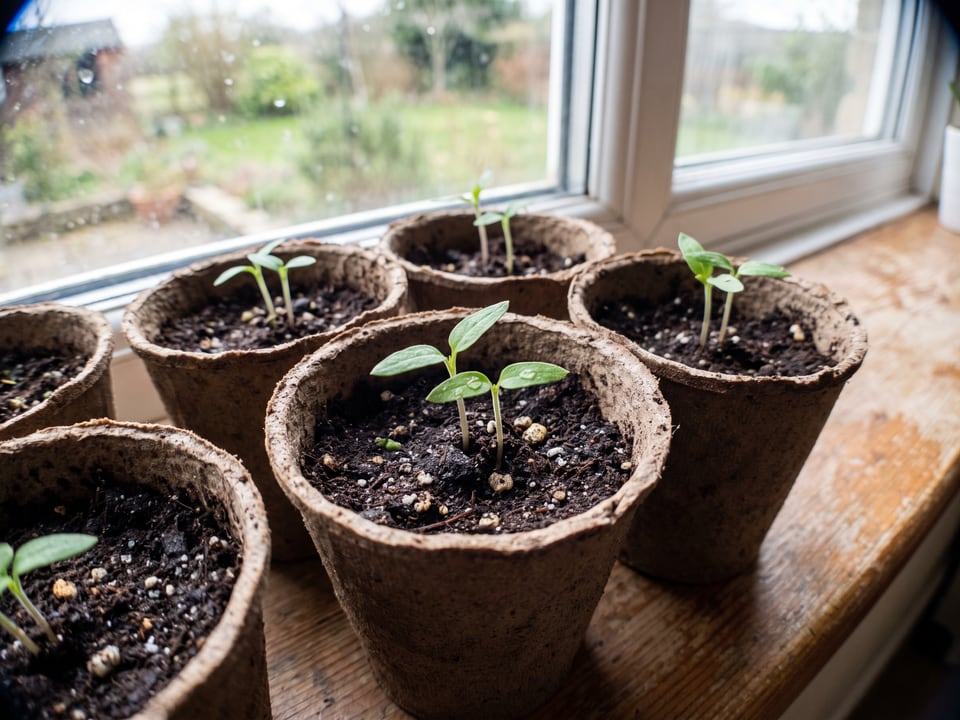
Start tomato seeds indoors 6 to 8 weeks before your average last frost date, sow them a quarter inch (6 mm) deep in damp seed compost, and keep the mix at 75 to 85°F (24 to 29°C) until they sprout, the University of Minnesota range. That is the whole answer for timing. Everything below is what happens on either side of it, in the order you will meet it.
One number decides your calendar and it is not on the seed packet: your own last frost date. Look yours up by ZIP code — it comes from the nearest weather station with thirty years of records, and it moves by weeks across a single state. Count backwards from that date, not from a month someone else’s garden runs on.
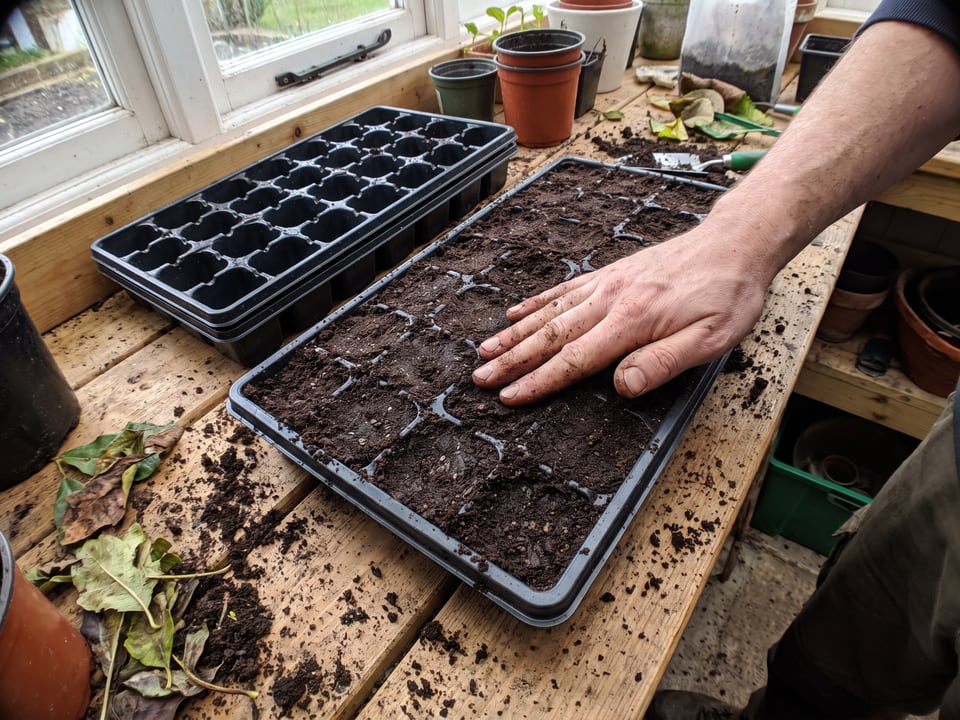
When to start tomato seeds indoors
Utah State University Extension allows six to eight weeks to grow tomato transplants, and University of Minnesota Extension starts seed five to six weeks before planting outside. Utah State describes a good transplant as stocky, with 5 to 7 leaves and 6 to 10 inches (15 to 25 cm) tall. Start earlier and you get a plant that outgrows its cell and stalls; start later and you transplant something too small to shrug off a cold week.
Working an example in reverse with Utah State’s range: if your last frost is May 15, you sow between March 20 and April 3. The plants go out somewhere between May 15 and the end of the month, once the soil has warmed.
The planting calculator does that arithmetic for every variety in the catalog once you give it your frost date.
There is one case for starting later on purpose. If you have no supplemental light and only a north window, a seedling started in early March spends six weeks getting leggy. Sowing two weeks later, closer to real daylight, gives a shorter plant that catches up in the ground.
How deep, and how many seeds per cell
A quarter inch (6 mm). Tomato seed is small and pushes through easily at that depth, and the most common failure with deeper sowing is not depth itself, it is that a seed sitting in cold wet mix for two extra days rots.
Sow two seeds per cell and cut the weaker one off at the surface when both come up. Pulling it out tears the roots of the one you are keeping. Two per cell is insurance against a dud, not a way to grow two plants: seedlings sharing a cell compete for a root run about the size of a shot glass.
Use a fine seed-starting mix, not garden soil and not standard potting compost with chunky bark. Water the mix before sowing rather than after, so the seed stays at the depth you put it.
How long tomato seeds take to germinate
Our records estimate 6 to 10 days for most varieties and 7 to 14 for the rest.
The University of Minnesota recommends a heating mat to hold the flat at 75 to 85°F (24 to 29°C) until seedlings emerge, and 70°F (21°C) once they are up.
Take the tray off the heat mat as soon as the first seedlings are up. Warmth after emergence, with weak light, is exactly the combination that produces a stretched, pale plant that never recovers.
Light, and why windowsills disappoint
Seedlings need 14 to 16 hours of strong light a day. A south window gives a fraction of that in March and the plant tells you so by stretching: long gaps between leaves, a stem that will not hold itself up.
Keep a shop light or LED panel 2 to 3 inches (5 to 8 cm) above the leaves and raise it as the plants grow. That distance looks wrong to people the first time. It is not.
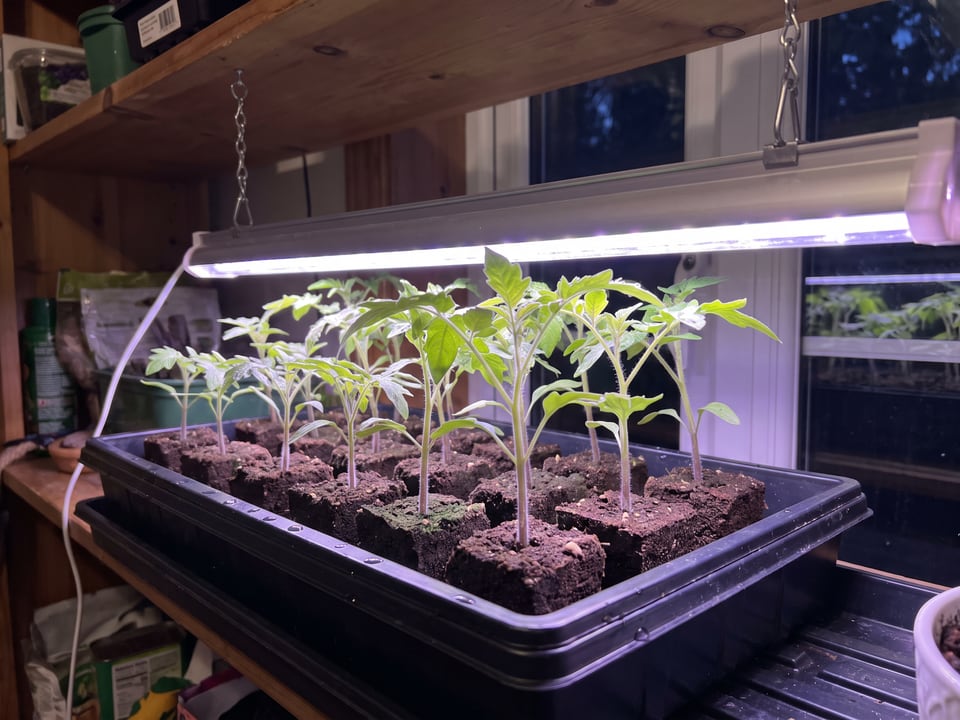
A fan on the tray for an hour a day, or a hand run over the tops, thickens stems and reduces the damping-off that kills seedlings at soil level in still, damp air.
Potting on
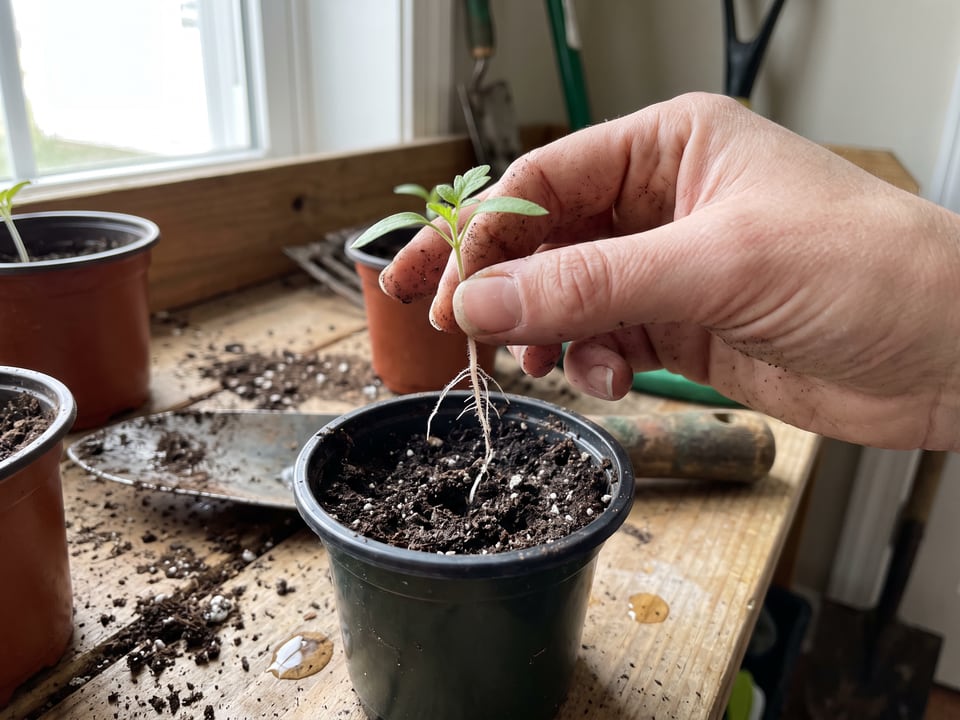
When a seedling has its first pair of true leaves, the jagged ones that follow the two smooth seed leaves, it is ready to move into a 3 to 4 inch (8 to 10 cm) pot.
Lift it by a seed leaf, never by the stem. A crushed stem is fatal and a torn seed leaf is not.
Plant it deeper than it was, up to the seed leaves. Tomatoes root along buried stem, which is why a leggy seedling is recoverable and why this step is the standard fix for one.
Hardening off
Seven to ten days before transplanting, start putting the plants outside: an hour in shade on day one, building up to a full day in sun and finally a night out. Skipping this is how a healthy plant gets sun-scalded white patches in an afternoon.
Wind matters as much as sun. A plant that has never moved has a stem built for still air.
When to transplant tomato seedlings
Two conditions, both of them, and neither is a date:
- Night temperatures staying above 50°F (10°C).
- Soil warmer than 60°F (15°C).
Plant deep again. The University of Minnesota strips the lowest leaves, lays the plant in a trench 3 to 4 inches (8 to 10 cm) deep and buries the stem up to just below the lowest remaining leaves. Utah State spaces transplants 2 feet (60 cm) apart, in rows 2 to 3 feet (60 to 90 cm) apart. Micro dwarfs need far less, and our catalog estimates roughly 10 inches (25 cm) for them.
Get the support in at the same time. Driving a stake beside an established plant cuts roots, and the guide to stakes, cages and strings has the sizes.
How long from seed to the first ripe tomato
Days to maturity on a seed packet is counted from transplant, not from sowing. That is the single most misread number in the whole business, and every record in our catalog uses the same basis, so you can compare them directly.
Real total, seed to first fruit: add the 6 to 8 weeks indoors to the days to maturity. An early variety at 55 days from transplant is about 100 days from the day you sowed it.
The spread across the catalog is wide enough to matter for a short season:
| Variety | Days from transplant | Habit |
|---|---|---|
| Siletz | 52 | Determinate |
| Glacier | 55 | Determinate |
| Stupice | 55 | Indeterminate |
| Red Robin | 55 | Micro dwarf |
| Gold Nugget | 58 | Determinate |
| Oregon Spring | 58 | Determinate |
| Early Girl | 59 | Indeterminate |
| Giant Oxheart | 88 | Indeterminate |
| Yellow Brandywine | 90 | Indeterminate |
Five weeks separate the top of that list from the bottom. In a short season that is the difference between a crop and a bucket of green fruit in October. The early season list is filtered on that field.
Saving your own seed
If you would rather keep seed from your own plants than buy it again, that works for open-pollinated varieties and not for hybrids: how to save tomato seeds covers which is which and why.
What usually goes wrong
Nothing comes up. Almost always cold mix or old seed. Check the tray temperature before you blame the seed.
Seedlings fall over at the base. Damping-off, a fungus in still damp air. Improve airflow, water from below, and do not reuse unwashed trays.
Long pale stems. Not enough light, or too much heat after germination. Pot on deeply and fix the lamp.
Sources: University of Minnesota Extension, Utah State University Extension.