How to support tomato plants: stakes, cages, strings
Sep 16, 2026 · 8 min read
How tall tomatoes actually grow, what each support costs and holds, and how to tie a stem so it does not girdle. Pick the support in May, not in July.
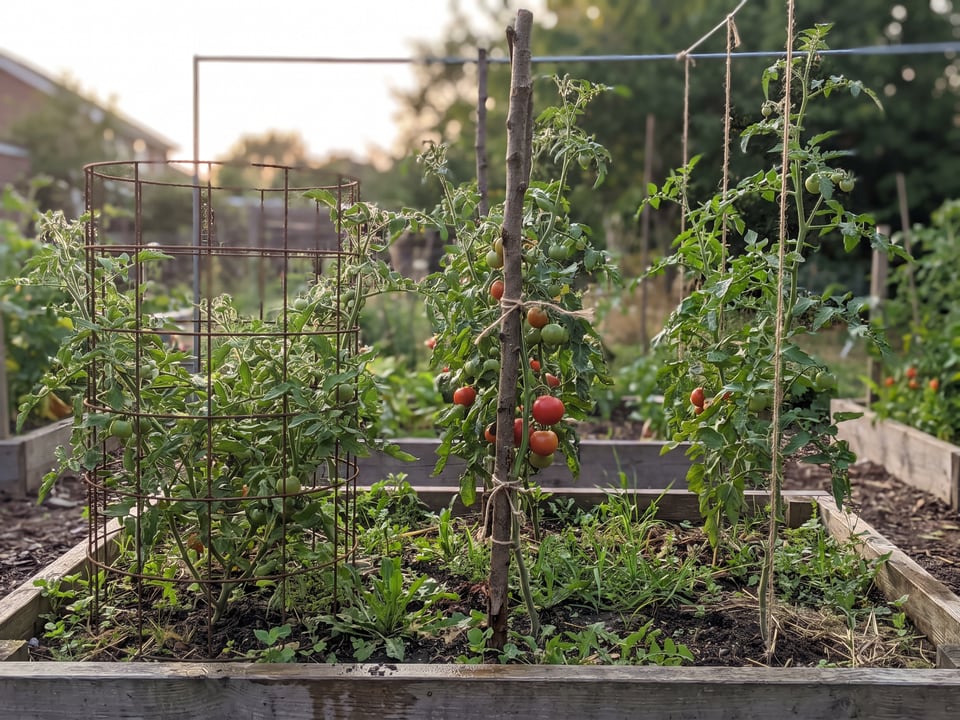
Match the support to the height the variety reaches, put it in at planting time, and tie with something soft in a figure eight. A tomato plant carrying a full crop is heavier than people expect.
Supports fail in July because they were chosen in May for a plant that was 8 inches tall. Work backwards from the variety instead.
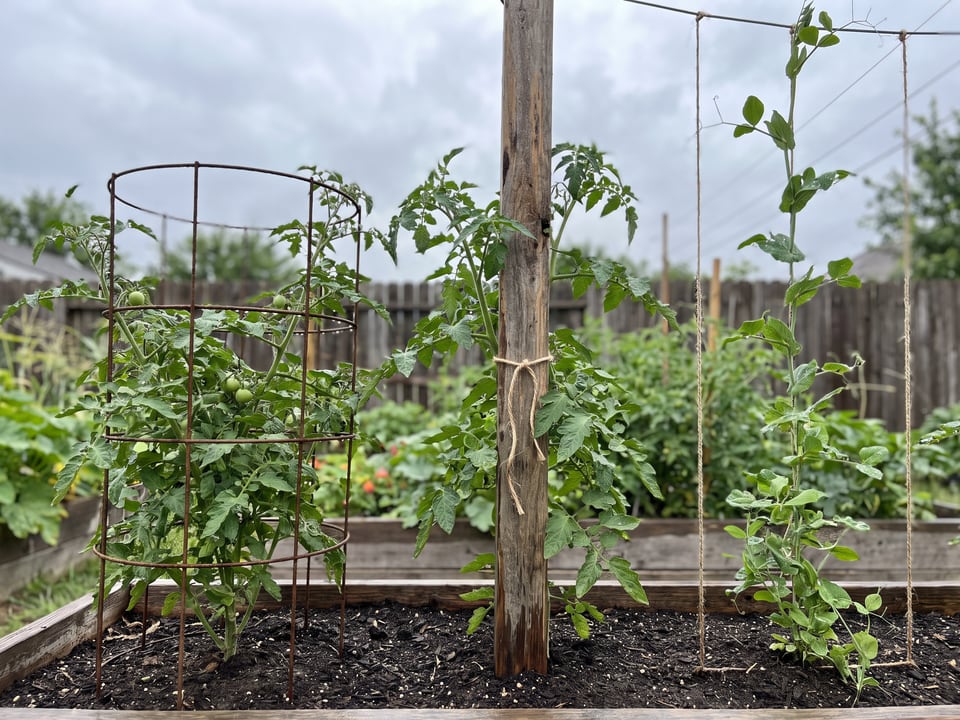
How tall do tomato plants grow
It depends entirely on growth habit, and the spread across our catalog is large enough that a single answer would be useless:
| Growth habit | Height range in the catalog | Typical mature height | Support needed |
|---|---|---|---|
| Micro dwarf | 5 to 12 in (13 to 30 cm) | 10 in (25 cm) | None |
| Dwarf | 12 to 36 in (30 to 90 cm) | 2 ft (60 cm) | A cane in wind |
| Determinate | 2 to 4 ft (60 to 125 cm) | 4 ft (120 cm) | Cage or short stake |
| Semi-determinate | 3 to 5 ft (90 to 150 cm) | 5 ft (150 cm) | Cage or 5 ft stake |
| Indeterminate | 3 to 10 ft (90 to 300 cm) | 8 ft (240 cm) | 6 to 8 ft stake or string |
The tall end is real. Sungold runs 7 to 10 feet (210 to 300 cm) in a good season under cover, and several indeterminate heirlooms sit at 8 feet (240 cm). A 4-foot cage on a plant like that stops being a support in June and starts being an obstacle.
Match the support to the habit
Indeterminate varieties keep growing until frost. They need a support that is tall from the start, because adding height to a loaded plant in August is a job nobody enjoys.
Determinate varieties stop at a fixed height and carry their crop in a concentrated flush. The load arrives all at once, which is hard on a flimsy cage, but it does not need height. Utah State Extension notes that determinate types are generally grown on the ground.
Dwarf and micro dwarf plants often need nothing. A thick-stemmed dwarf at 2 feet (60 cm) holds itself up; a single cane helps when a pot is in a windy spot.
The four options, with what they cost
A single stake. A 6 to 8 foot (1.8 to 2.4 m) wooden stake or 1-inch (25 mm) square timber, driven 18 inches (45 cm) into the ground, 3 to 4 inches from the stem, before you plant, as Utah State specifies. It is reusable for years. It suits an indeterminate plant pruned to one or two stems, and it needs tying every 8 to 12 inches (20 to 30 cm) as the plant grows. That tying is the real cost: a dozen plants is a weekly job all season.
A cage. A cylinder of wire mesh around the plant. Nothing to tie, and a determinate plant can be left unpruned inside it, which is why it is the least work of any method.
The cone-shaped cages sold in garden centers are usually too small. Make your own from concrete reinforcing mesh: a 5-foot (1.5 m) length rolled into a cylinder about 20 inches (50 cm) across holds anything and lasts for years. Store them stacked; they take space over winter.
String from an overhead wire. What commercial growers use under cover, and the best option in a greenhouse or polytunnel. A wire runs above the row, a string drops to each plant, and the plant is wound around the string every week as it grows. Pennies per plant, two minutes a week, and it needs a structure overhead that can carry the weight of the whole row.
The Florida weave. Twine run between posts along a row of plants, one course every 8 inches (20 cm) of growth. It suits a long row of determinate plants, uses one post per two or three plants, and it is fast once you have done it once. Cheapest per plant for a row of ten or more; fiddly for three plants in a mixed bed.
How to tie up tomato plants
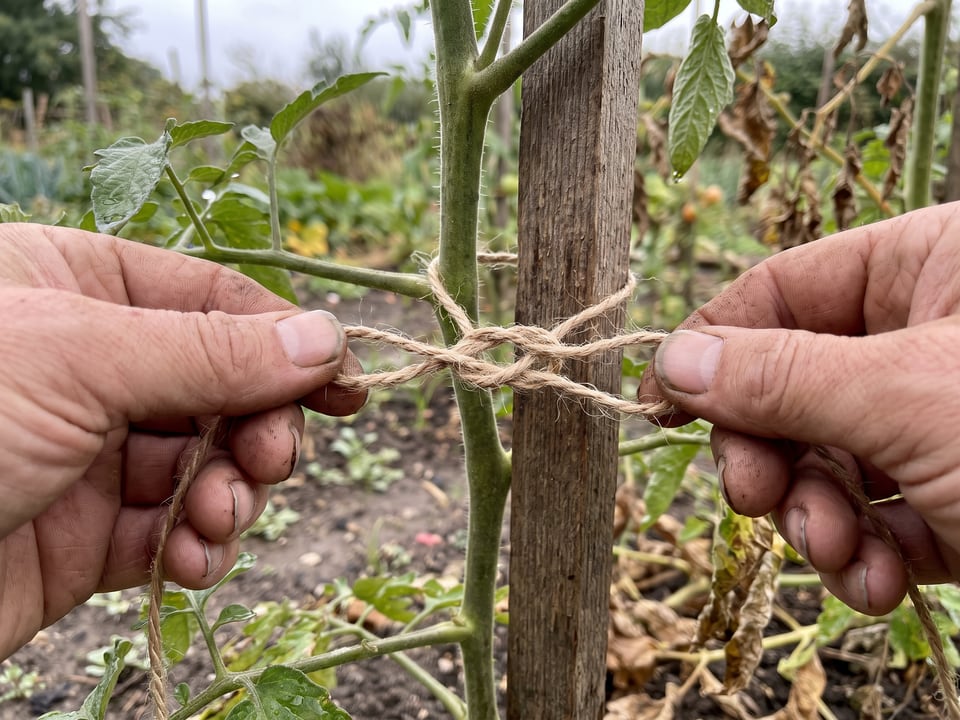
Use soft twine, strips of old cotton, or the clips sold for the job. Anything thin and hard cuts into a stem as it thickens, and wire ties can girdle a plant.
The knot: run the twine around the stake, cross it over, and bring both ends around the stem, so the twine makes a figure eight with the crossover between stem and stake. That cushion is the whole point, and it keeps the stem from rubbing on the wood.
Leave it loose. You should be able to slide a finger between the twine and the stem, because that stem will double in thickness before the season ends.
Tie just below a leaf node so the loop cannot slide down under load, and place ties every 8 to 12 inches (20 to 30 cm) of stem.
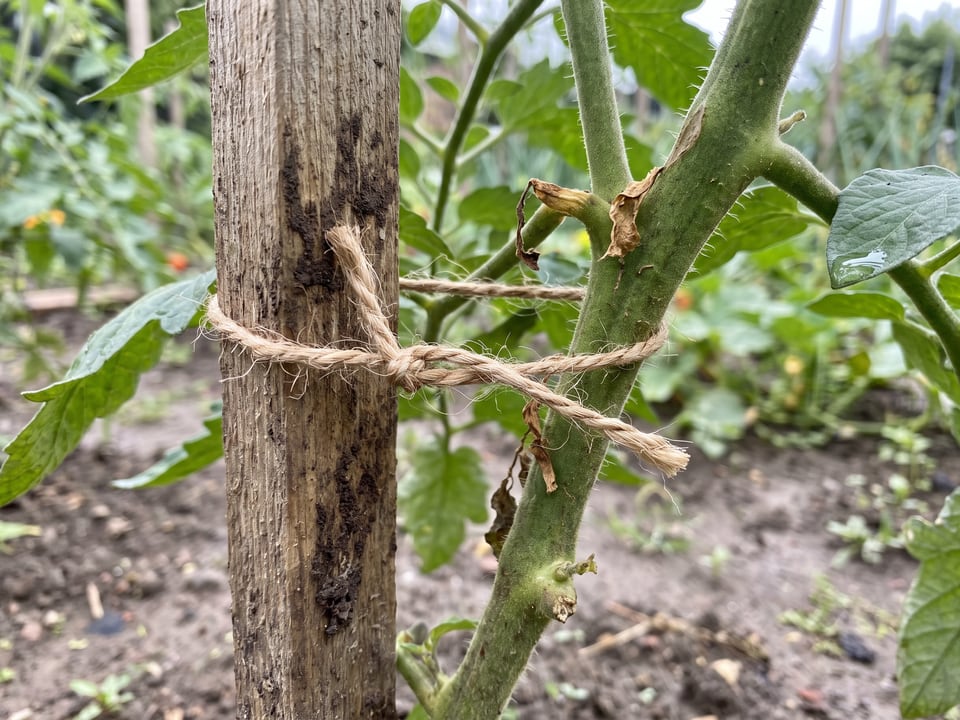
Check the ties every couple of weeks. A stem that was loose in the loop in June can be tight in it by late July.
Get it in before the plant needs it
Set the support at planting time, or within two weeks. Driving a stake next to an established plant cuts roots you cannot see. Setting a cage over a 4-foot plant means either bending the plant or lifting the cage over trusses you will knock off.
The mistake costs more under cover than outside, because a greenhouse plant grows faster than you expect in the first warm week.
What the load actually is
Fruit weight decides the gauge of wire and the thickness of the stake. Our variety pages carry a fruit weight range for every entry, and the plants that need the sturdiest support are the beefsteak types, where a single fruit runs 10 to 16 ounces (280 to 450 g) and a truss of four weighs more than a bag of sugar.
Cherry types are light per fruit and heavy per truss, because there are twenty of them. Either way the support is holding the stem, and the stem is holding everything above it.
A support also carries wind. A staked 8-foot plant in an exposed garden takes more load from a summer storm than from its own fruit, which is the argument for a driven stake over a pushed-in cane.
Supporting tomatoes in pots
The pot has to hold the support and the support has to hold the plant, and in a container the limiting factor is usually the pot tipping over.
A single 4-foot (1.2 m) cane suits a dwarf or determinate in a 5-gallon (20 L) pot. For an indeterminate you need 6 feet (1.8 m) of cane and a pot wide enough at the base not to go over in wind, which in practice means wider than it is tall, or a pot standing against a wall with the cane tied to something. Sizes by habit are in growing tomatoes in pots.
Three canes pushed in around the rim and tied at the top make a tripod, which is far more stable in a container than one cane in the middle.
Support and pruning are one decision
A staked plant is a pruned plant. Single-stem growing up a stake or a string only works if you take the side shoots off, and a cage only works if you do not, because a caged plant needs its own foliage to fill the cage.
So the choice runs: stake plus string and pruning to one or two stems, with weekly tying. Or a cage and less work. Utah State notes that semi- and indeterminate varieties require more support and vine pruning to keep plant size manageable. How to prune tomato plants covers which cuts go with which.
Sources: University of Minnesota Extension, Utah State University Extension.