How to prune tomato plants, and when not to
Sep 16, 2026 · 7 min read
Prune indeterminate tomatoes, leave determinate ones alone. What a sucker is, where to cut, when to top a plant, and what pruning costs you if you get it backwards.
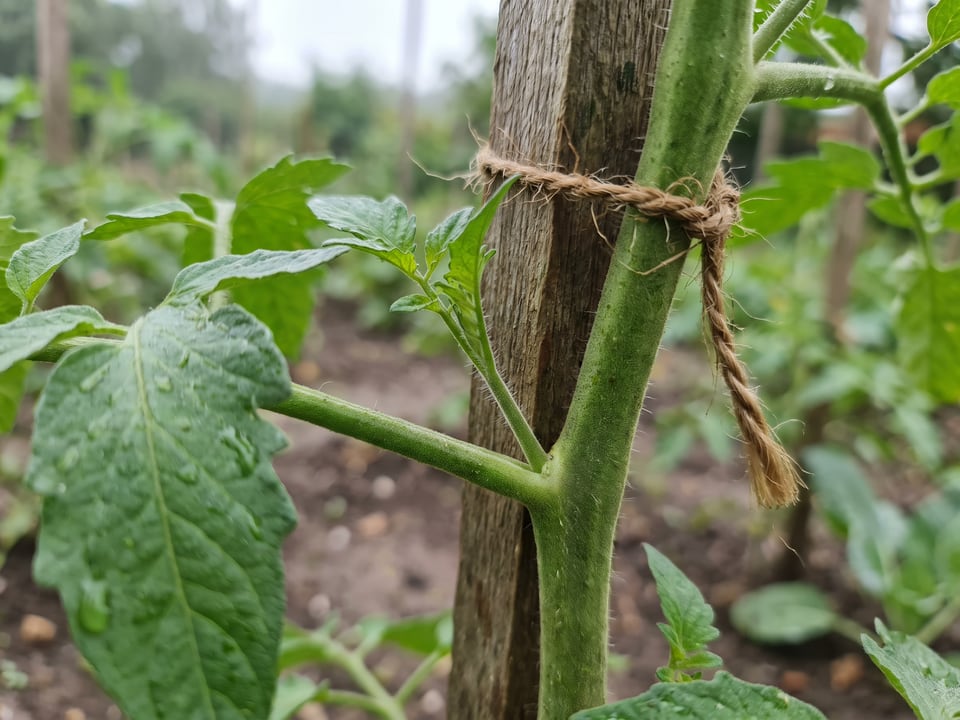
Prune indeterminate tomato plants and leave determinate ones alone apart from their lowest leaves. That one line decides most of it, and it is why pruning advice copied from someone else’s garden so often costs people fruit: the two plant types respond to the same cut in opposite ways.
Start with the growth habit on the variety page. An indeterminate plant grows from a single tip until frost kills it, so it keeps making new stems all season and can be managed. A determinate plant grows to a genetically fixed height, sets its flowers and stops. Every side shoot it makes is a place fruit will form, so removing them removes the crop.
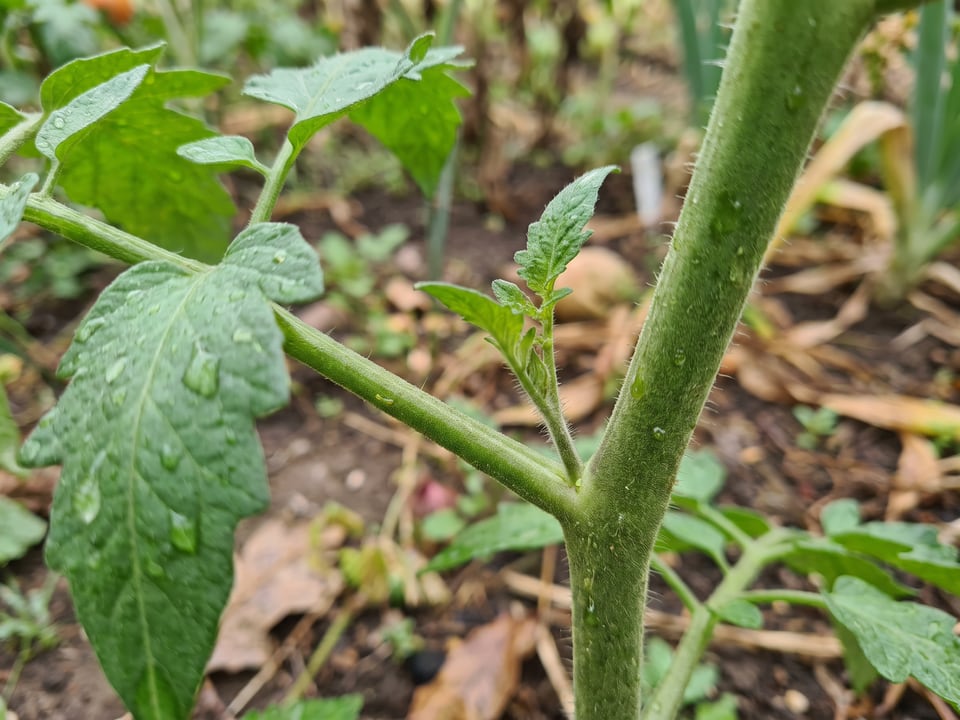
What a sucker is and where to find it
A sucker is a side shoot: a new stem that grows out of the 45-degree angle where a leaf meets the main stem. That junction is called the leaf axil, and it is the only place a sucker appears.
It is easy to misidentify when you first look. Three things grow off the main stem: leaves, flower trusses and suckers. A leaf comes straight off the stem. A truss comes off the stem between leaves and carries flowers, no leaves of its own. A sucker comes out of the V between a leaf and the stem, and it has its own small leaves, because it is a whole plant in miniature.
Left alone, a sucker becomes a second main stem with its own leaves, its own trusses and its own demand for water. That is not automatically bad. It is a choice about where the plant spends what it makes.
How to remove a sucker
Take them off while they are small enough to snap between finger and thumb. Bend it sideways until it breaks at the base rather than pulling it downward, which tears a strip of stem skin with it.
Do it in the morning, when the plant is full of water and the shoot breaks cleanly, and do it weekly. A shoot you missed for two weeks needs pruners and leaves a real wound, and a wound is a way in for disease.
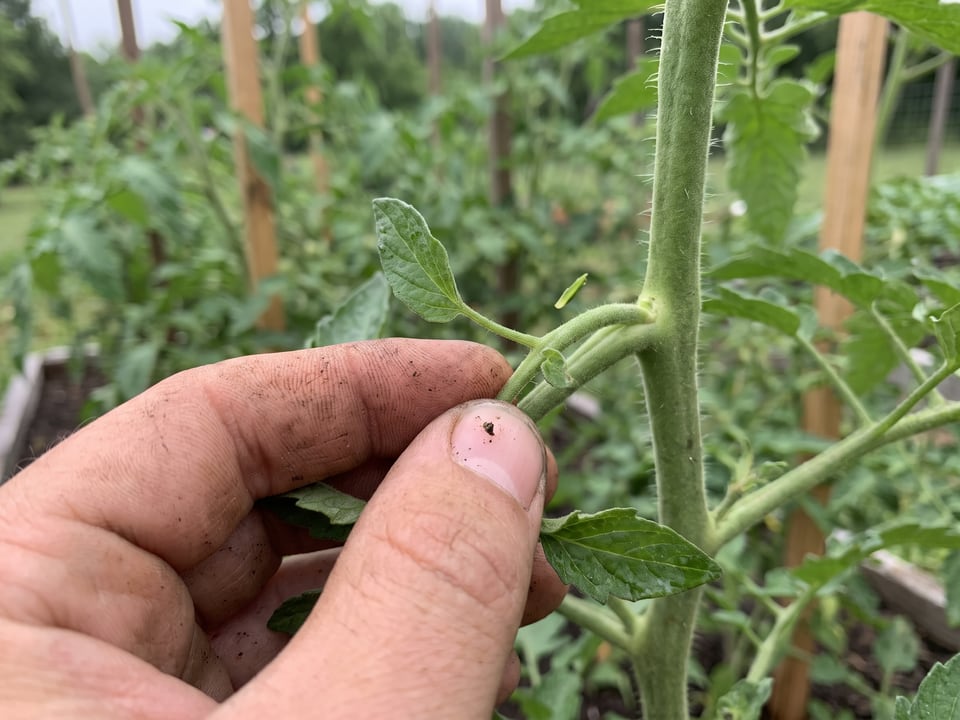
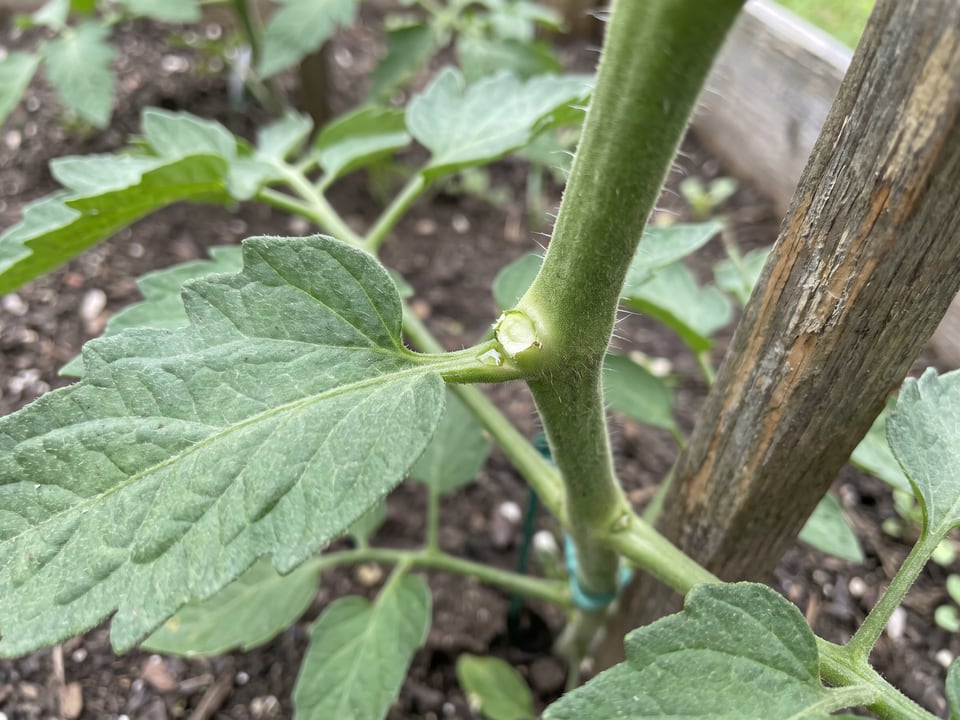
Use clean pruners for anything thicker than a pencil, and cut close to the stem without cutting into it.
The point is not tidiness. A single-stemmed plant puts a larger share of what it makes into the trusses it already carries, ripens earlier, and lets air through the canopy. Utah State lists pruning among the practices that keep semi- and indeterminate plants manageable.
Lower leaves
Leaves that touch the soil are how soil-borne fungal spores get onto a plant. Take off everything below the first fruiting truss once that truss has set, and keep the lower stem clear for the rest of the season.
This part applies to determinate plants too. It is the one cut that helps every tomato.
Do not strip much further than that. The leaves above a truss feed it, and a plant stripped bare to “let the sun in” ripens no faster. The University of Minnesota says warmth matters more than light for ripening, and exposed fruit is what gets sunscald.
Container plants of any habit want the lower leaves cleared, because watering splashes compost onto them constantly.
Should you prune a determinate tomato
No, apart from the lower leaves. A determinate plant has a fixed number of trusses written into it, and every sucker you remove is a stem that would have carried some of them. The University of Minnesota says bush-type plants, such as Roma or Oregon Spring, do not need pruning.
Semi-determinate varieties such as Marmande sit in between: they keep growing for a while and then slow down. Treat them as determinate and take only the lower leaves.
Dwarf and micro dwarf varieties are compressed by genetics, not by your pruners. They carry short internodes and thick stems, and a micro dwarf that reaches 10 inches (25 cm) has no side shoot worth removing. Take the lower leaves off if they lie on the compost and otherwise let them be.
When to prune tomato plants
Start once the plant has set its first truss, then go over it weekly.
Prune in the morning, in dry weather, so the wounds close before evening. Wet foliage and fresh cuts in the same afternoon is how bacterial problems spread down a row.
Stop pruning suckers late in the season. At that point new stems have no time to ripen anything, and the plant is better left with the leaf area it has.
Topping tomato plants
Topping is cutting the growing tip off an indeterminate plant, two leaves above the highest truss you think will ripen. The plant stops making new trusses that have no chance and puts what it has into the fruit already set.
Time it by your first frost date, which you can look up with your last frost date by ZIP code. In a short season this single cut is often the difference between a truss that ripens and one you pick green in October.
The date matters more than the technique. Look at the days to maturity on the variety page, which our catalog counts from transplant on a consistent basis, and count backwards from your own frost date rather than from a number in a book written for someone else’s climate. The sowing calendar works the same arithmetic from the other end of the season.
Two other times to top a plant: when it has reached the top of its support and you have nowhere to put more growth, and when it has reached the greenhouse roof.
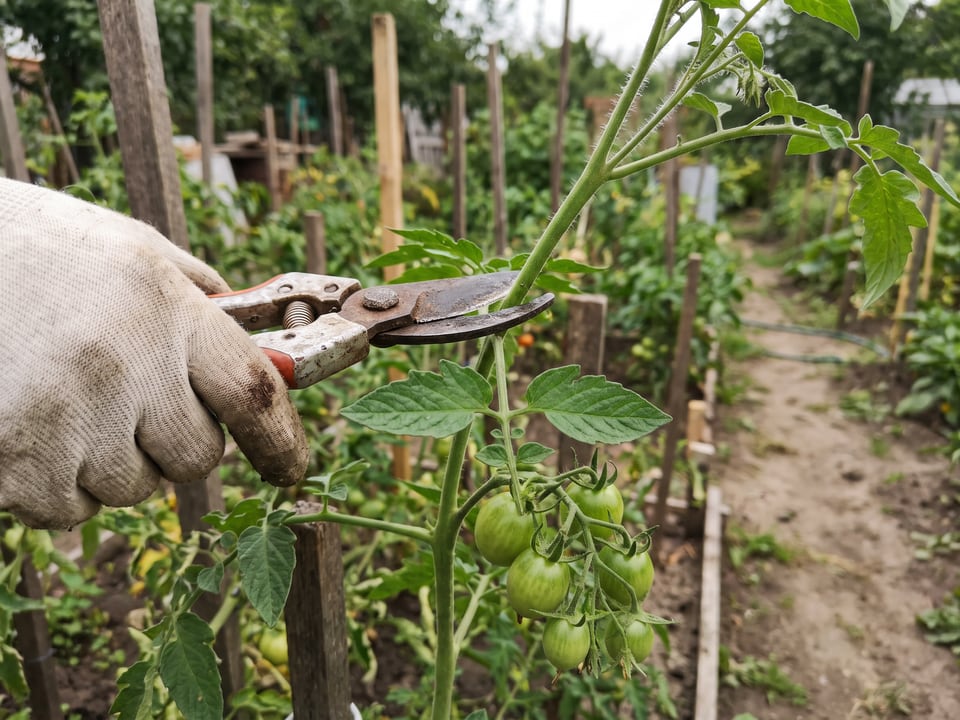
How to prune cherry tomato plants
The same way as any other indeterminate, with one adjustment: most cherry varieties produce suckers faster than beefsteaks and carry their crop on long, branching trusses.
Strict single-stem pruning works and gives earlier, cleaner fruit. Two stems is a common alternative. Pick the strongest sucker just below the first flower truss, let it run, and remove everything else.
Sungold, Black Cherry and Sweet 100 all take this treatment. In a pot, one stem: the root volume decides the ceiling, not the pruning.
Two exceptions worth knowing
If a plant is going to run out of season before it fills its space, letting one low sucker grow into a second stem gives you more trusses on the same root system.
If the main growing tip gets damaged, the topmost sucker is your replacement leader. Leave it, tie it in, and carry on.
Hygiene, briefly
Utah State notes that tomato viruses spread by brushing against infected plants and from tobacco products. If you prune a plant that looks mottled or distorted, do it last, and clean the blades afterwards. Do not use tobacco products when handling the plants.
Snapping shoots by hand avoids the blade question entirely, which is one more reason to do it while they are small.
What pruning does not fix
It does not fix a plant short of water, short of feed or short of light. A pruned tomato in a 3-gallon pot in full shade is still a tomato in a 3-gallon pot in full shade.
It also does not fix disease that has already arrived. If the lower leaves are yellowing with spots rather than age, work through the diagnosis before you strip the plant, because removing half the foliage of a stressed plant makes it worse.
Pruning directs what the plant has. It cannot add what the plant never got.
Sources: University of Minnesota Extension, Utah State University Extension.