Yellow leaves on tomato plants: how to tell what is wrong
Sep 16, 2026 · 8 min read
Work from the bottom of the plant up. 8 causes of yellowing tomato leaves, how to tell them apart by pattern, and what to do about each one today.
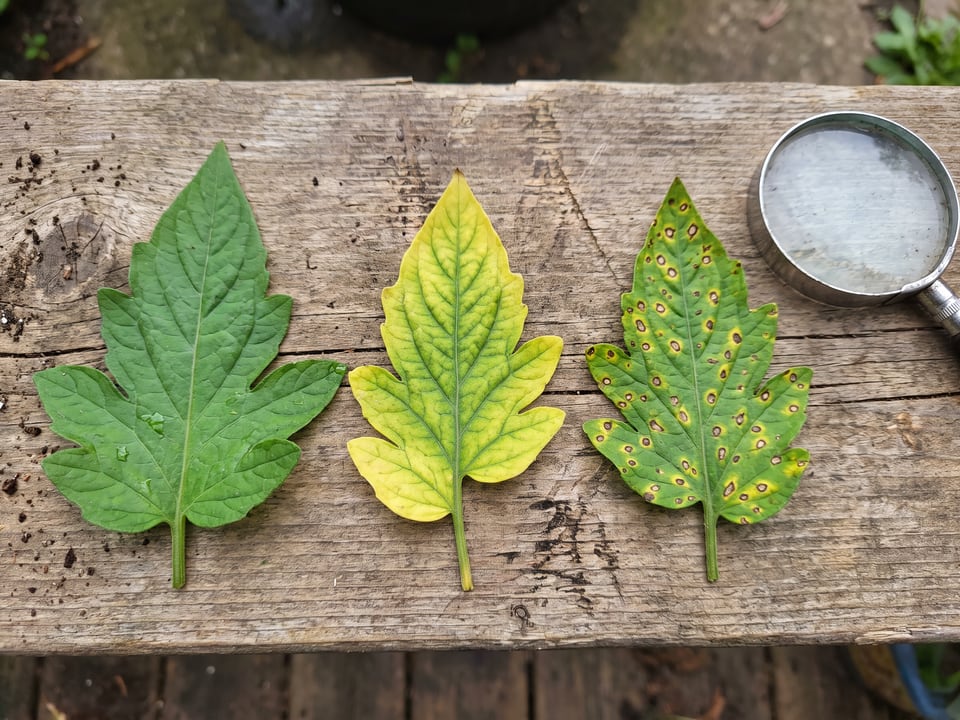
Start at the bottom of the plant and read the pattern as well as the color. Yellow lower leaves on a tomato are often either normal aging or too much water, and both are common enough that reaching for a treatment is usually the wrong first move. Disease is further down the list of probabilities, and it announces itself with spots and rings rather than plain yellowing.
Three questions answer most cases. Where on the plant is it? Is the yellowing uniform, between the veins, or spotted? And is the soil actually wet?
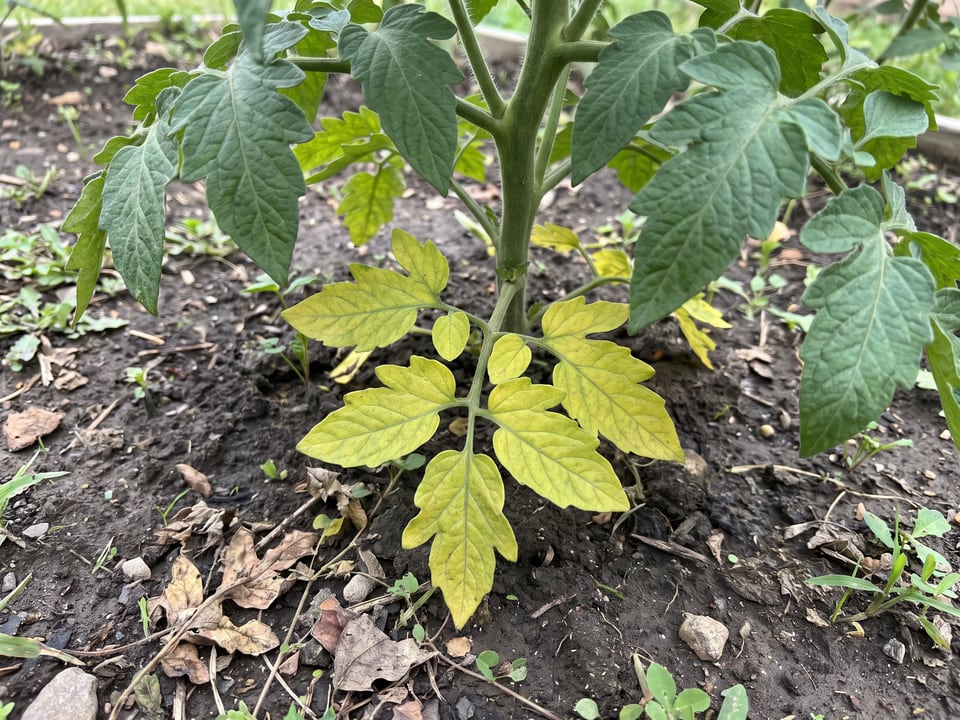
Normal aging of the lowest leaves
The two or three leaves closest to the ground turn yellow on almost every tomato plant at some point in the season. The plant is pulling nitrogen out of its oldest, most shaded leaves and moving it into new growth and fruit. It is doing what it should.
How to recognize it: only the bottom leaves, uniform yellowing without spots, upper plant green and growing, progress is slow.
What to do: remove them once they are more yellow than green. Clemson Extension advises trimming off infected lower leaves to slow leaf disease.
Overwatering and poor drainage
A common cause, and the easiest to make worse by treating it as a feeding problem.
Roots need air. Soil kept saturated suffocates them, the plant stops taking up nitrogen even when the soil is full of it, and the lower leaves go yellow. In containers it is usually blocked drainage holes or a saucer that never gets emptied.
How to recognize it: yellowing from the bottom, soil wet when you put a finger in it, sometimes a whole-plant droop that does not recover after watering.
What to do: stop watering until the top 2 inches (5 cm) are dry. Check drainage holes. If the plant is in a saucer, empty it. The watering guide has the volumes that avoid this.
Nitrogen shortage
Real, and less common in garden beds than people assume. Most likely in containers after six weeks, in sandy soil, and in beds that have grown heavy feeders for several seasons.
How to recognize it: uniform pale yellowing that starts at the lowest leaves and moves steadily up the plant, with the whole plant looking pale and growth slowing.
What to do: a balanced feed, or a nitrogen-leaning one before flowering. Do not overcorrect: excess nitrogen gives you a big green plant with little fruit. Fertilizer for tomato plants covers the phases.
Magnesium shortage
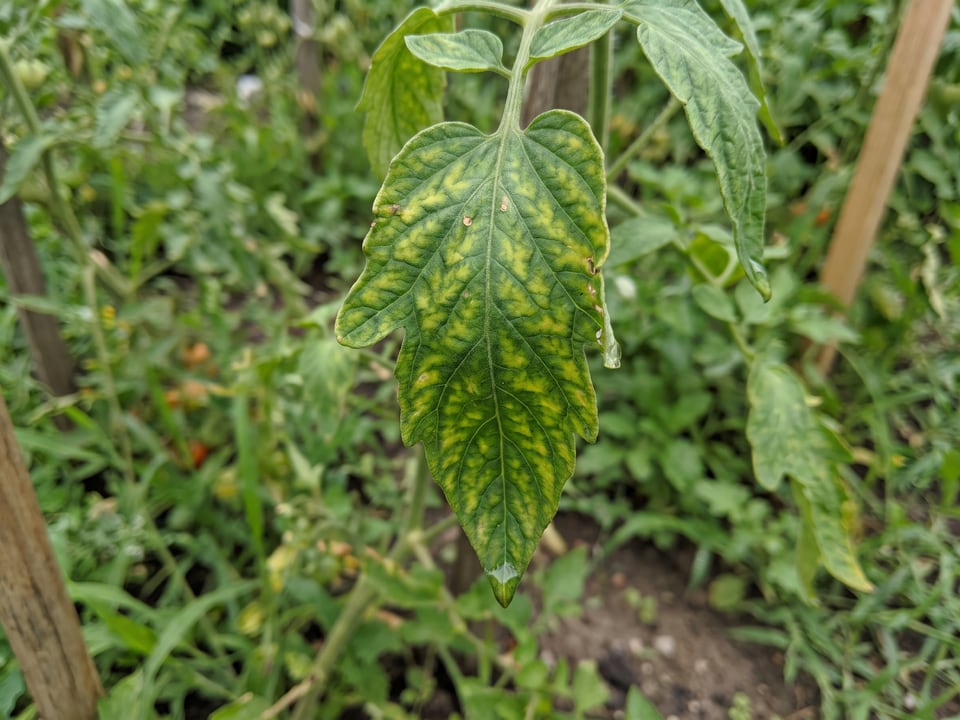
Distinctive enough to identify from across the garden once you know it.
How to recognize it: the vein network stays green while the tissue between the veins goes yellow, on the older lower leaves first. The leaf looks like a green skeleton on a yellow background.
What to do: a soil test before treating. Note that interveinal yellowing on the newest leaves instead points to iron, which is usually a pH problem rather than a shortage.
Septoria leaf spot
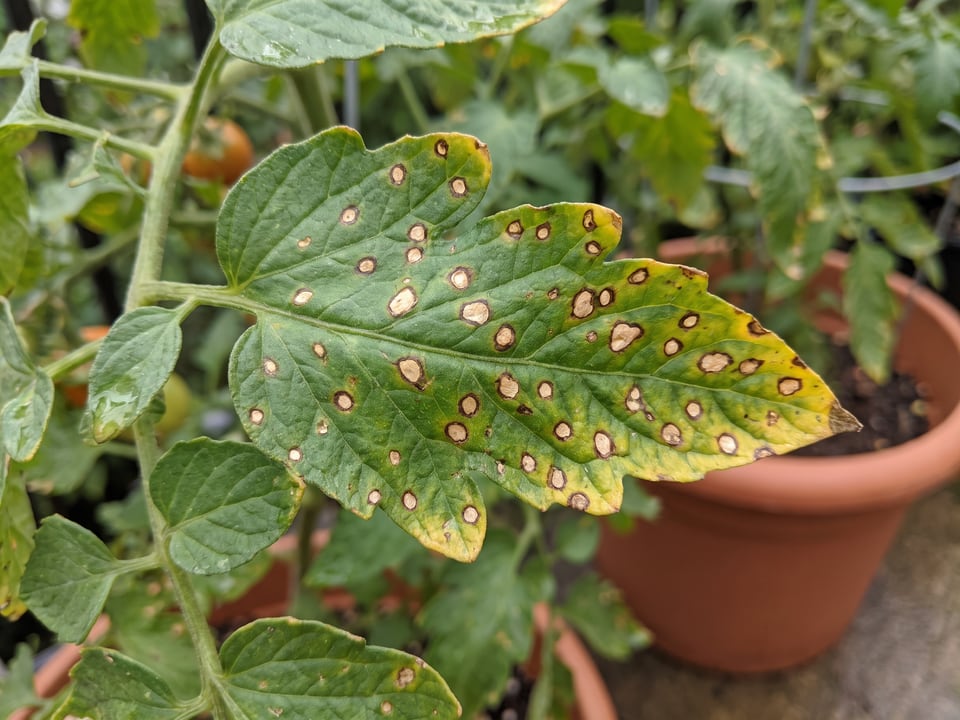
It usually starts on the lower leaves near the ground after the plants begin to set fruit. The fungus is not soil-borne, Clemson notes, but it overwinters on old crop debris.
How to recognize it: many small round spots, dark edges and pale gray centers, often with tiny black dots inside them. The leaf yellows around the spots and then dies. It works upward from the lowest leaves after a wet spell.
What to do: remove affected leaves and bin them, do not compost. Mulch the soil surface, water at the base, and space or prune for airflow. It rarely kills a plant but it strips foliage fast enough to cost you the top of the crop.
Early blight
Often confused with septoria, and treated the same way, but the mark is different.
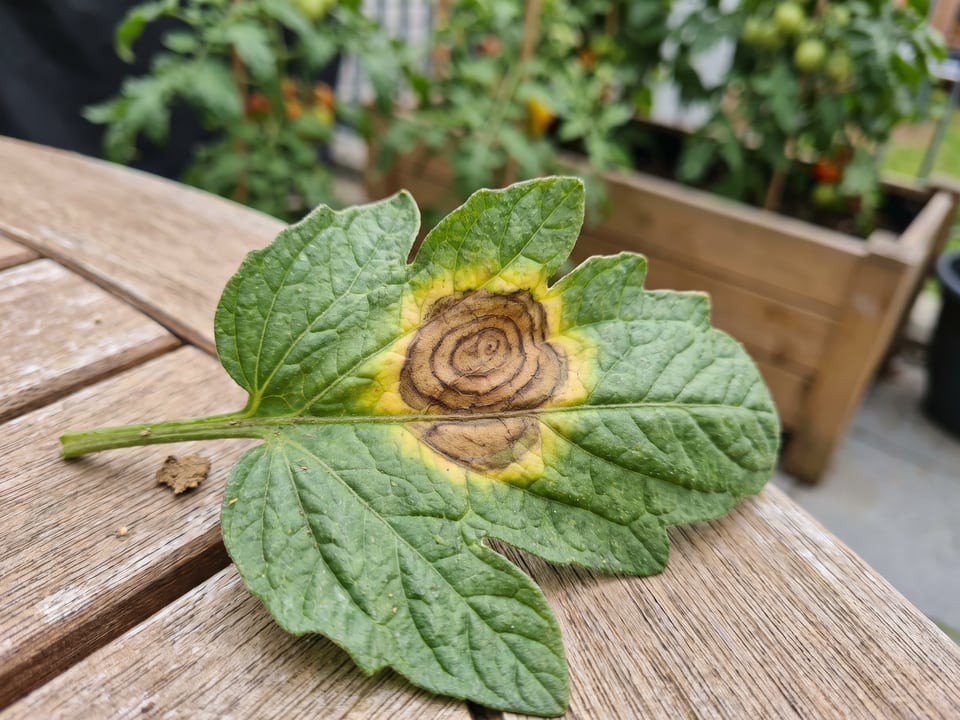
How to recognize it: larger brown lesions with concentric rings inside them like a target, surrounded by a yellow halo. Lower leaves first, and it can move onto stems and fruit shoulders.
What to do: the same hygiene, and it is the disease most worth choosing resistant varieties for if it hits you every year.
Fusarium and verticillium wilt
Soil-borne, and the one group on this page that ends the plant.
How to recognize it: yellowing and wilting often on one side of the plant or one side of a leaf, working up from the base, with the plant wilting in heat and not fully recovering overnight. Slice the stem near the base lengthwise: brown streaking in the tissue just under the skin confirms it.
What to do: nothing saves that plant. Pull it, do not compost it, and do not plant tomatoes, peppers, eggplant or potatoes in that spot for three years. Choose resistant varieties next season.
Viruses
Uncommon in home gardens, and worth recognizing so you do not treat something else for weeks.
How to recognize it: mottled light and dark green leaves, distorted, narrow or fernlike, and stunted growth. Clemson describes tobacco mosaic virus as mottling the older leaves.
What to do: pull and bin the plant. Tomato mosaic virus survives on hands and tools, and in cured tobacco, so wash before handling other plants.
Transplant shock
Two weeks after planting out, some yellowing of the oldest leaves while the plant establishes its root system is normal, especially if it went into cold soil.
What to do: nothing except keep water steady. It grows out of it. Planting into soil at 60°F (15°C) or warmer avoids most of it: the sowing and transplanting calendar has the thresholds.
The quick table
| Pattern | Where | Cause | Today |
|---|---|---|---|
| Uniform yellow, no spots | Lowest 2 to 3 leaves only | Aging | Remove them |
| Uniform yellow, soil wet | Bottom, spreading | Overwatering | Stop watering, check drainage |
| Uniform pale, whole plant | Bottom upward | Nitrogen | Feed |
| Yellow between green veins | Older leaves | Magnesium | Drench, then soil test |
| Small spots, pale centers | Lowest leaves up | Septoria | Strip leaves, mulch, water at base |
| Rings in brown lesions | Lowest leaves up | Early blight | Same, plus resistant varieties next year |
| One-sided yellowing and wilt | Base upward | Fusarium or verticillium | Pull the plant, rotate 3 years |
| Mottled, distorted | Newest growth | Virus | Pull, wash hands and tools |
Why is my tomato plant wilting
If the soil is dry, it is thirsty. If the soil is damp and the plant is wilted, do not water it again: that is the reflex that finishes off plants with root or stem problems.
Damp soil plus wilting means one of three things. Root rot from waterlogging, in which case drainage is the fix. A wilt disease, in which case the stem shows brown streaking inside and the plant is finished. Or stem damage at the base, from a cutworm or physical injury, which you find by looking.
A plant that wilts at midday in full sun and is fine by evening is doing normal heat regulation, not asking for anything.
Why tomato leaves curl
Leaf curl gets searched almost as often as yellowing and it is usually the least serious thing on this page.
Upward, inward rolling of the lower leaves, leaves firm and green: physiological leaf roll, a response to heat, heavy pruning or irregular water. Minnesota Extension notes it does not noticeably reduce growth or yield.
Downward cupping with twisted, fernlike new growth: herbicide drift, most often from a lawn weedkiller, or from compost or straw mulch that carries residue. The plant may grow out of mild exposure; nothing you can spray fixes it.
Curling with mottling and stunting: virus, treated as above.
Varieties with documented disease resistance
Resistance is coded on our variety pages as letters, and those codes came from breeder documentation rather than a general claim: V verticillium, F1 and F2 fusarium races 1 and 2, N nematodes, T tobacco mosaic virus, EB early blight, LB late blight.
The strongest in the catalog against leaf disease:
- Mountain Magic: LB, EB, V, F1, F2
- Plum Regal: LB, EB, V, F1, F2, TSWV
- Juliet: EB, LB
- Verona: F1, V, EB
- Celebrity: V, F1, F2, N, T
- Purple Zebra: F1, LB, V, T
Those are hybrids, mostly. That is the honest trade in the heirloom versus hybrid question: heirlooms keep their seed true and rarely carry bred-in resistance, and if a wilt disease is established in your soil, a resistant hybrid is the difference between a crop and a dead plant in July.
Sources: Cornell University Vegetable Diseases, Clemson Cooperative Extension, University of Minnesota Extension, tomato disorders.