How to save tomato seeds for next year
Sep 16, 2026 · 7 min read
Ferment the pulp for a few days, rinse, dry, label. Which varieties come true, which never will, and how long saved tomato seed stays viable, from extension sources.
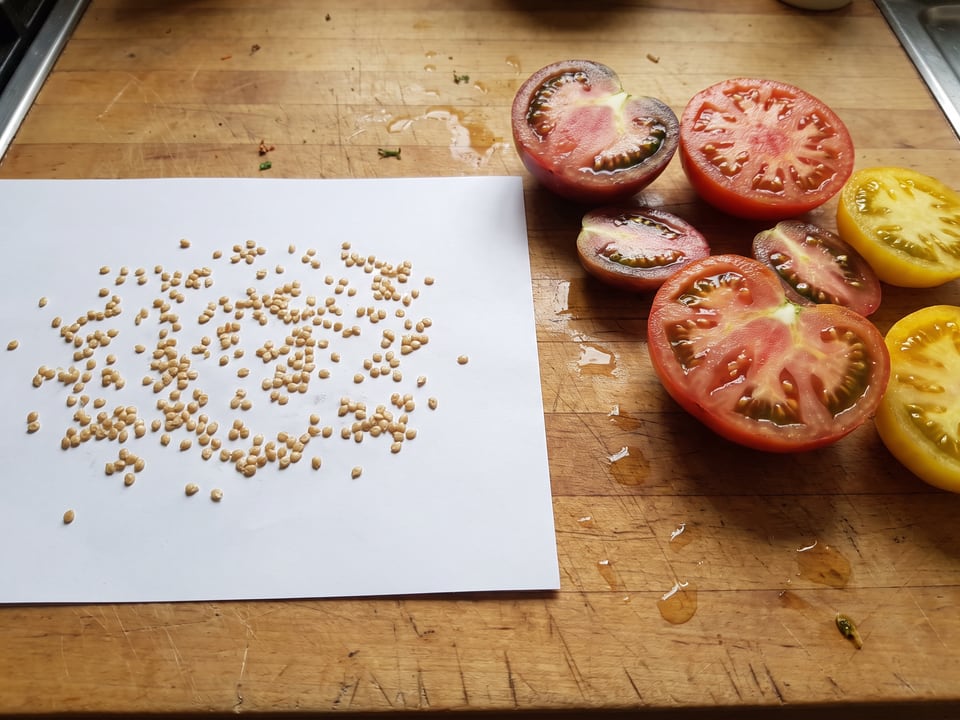
Scoop the seeds and their jelly into a jar with a little water, leave it a few days until it ferments and the good seed sinks, then rinse, dry and label. That is seed saving. Illinois Extension describes the fermentation step as what breaks down the gel coating around each seed, and Minnesota counts tomatoes among the easiest crops to save seed from, since the flowers pollinate themselves and the seed needs little treatment before storage.
The decision that matters comes before any of it. Save seed from the wrong plant and you get a careful jar of something that will not be what you picked.
Which tomatoes come true from seed
Three words on a variety page decide it, and ours carries one of them on every record:
Heirloom and open-pollinated varieties come true. Minnesota Extension puts it this way: seed from open-pollinated varieties such as ‘Big Rainbow’, ‘San Marzano’ and ‘Brandywine’ grows into plants very similar to the parent, with nearly identical fruit.
Hybrid F1 varieties do not. An F1 is the first generation from two deliberately crossed parent lines. Minnesota is clear that hybrids such as ‘Big Boy’ and ‘Early Girl’ still produce viable seed, but the plants grown from it are a new combination of the parents’ good and bad traits, and there is no predicting what the fruit will be like. The plants will grow; they simply will not be the variety on the label.
Our catalog holds 57 heirlooms, 51 other open-pollinated varieties and 24 F1 hybrids. So Sungold, Early Girl, Big Beef, Juliet and Celebrity are off the list, and the entire heirloom collection is on it. Check the Category line on the variety page before you cut the fruit, not after.
Whether your tomatoes will have crossed
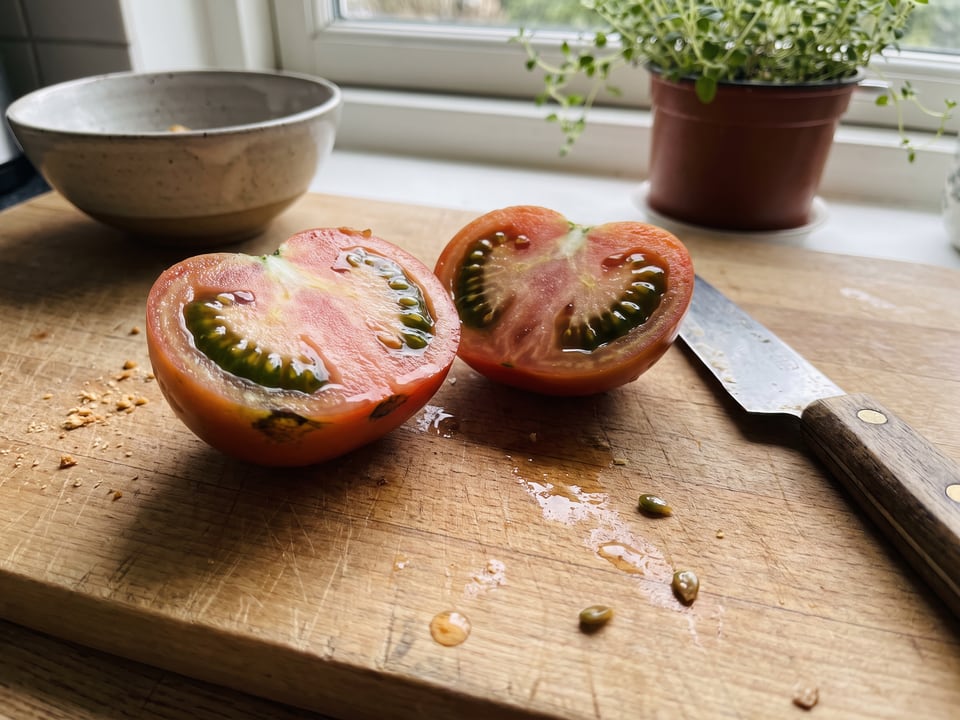
Tomato flowers are self-pollinating, so the risk of crossing is low, as Vermont Extension notes. Illinois Extension, working from Seed Savers Exchange figures, says tomatoes need only be a few rows apart, and gives a recommended isolation distance of 10 to 50 feet (3 to 15 m) for seed saving, since insects can still carry pollen between varieties.
If you are saving seed you care about, put distance between varieties, or bag a flower truss before it opens: Illinois lists a paper or nylon bag over the flowers as one of the standard isolation methods. For most people, in most gardens, the practical answer is to save from the plant furthest from the others and accept a small chance of a surprise.
The fermentation method, step by step
- Pick a fully ripe fruit from a healthy, vigorous plant that looked like the variety should. Minnesota’s advice is to choose only the most vigorous plants with the best fruit, and not to save seed from weak or off-type plants.
- Cut it across the middle and squeeze the seeds and jelly into a glass jar. Add a little water.
- Leave it somewhere warm, out of direct sun, and stir once or twice a day.
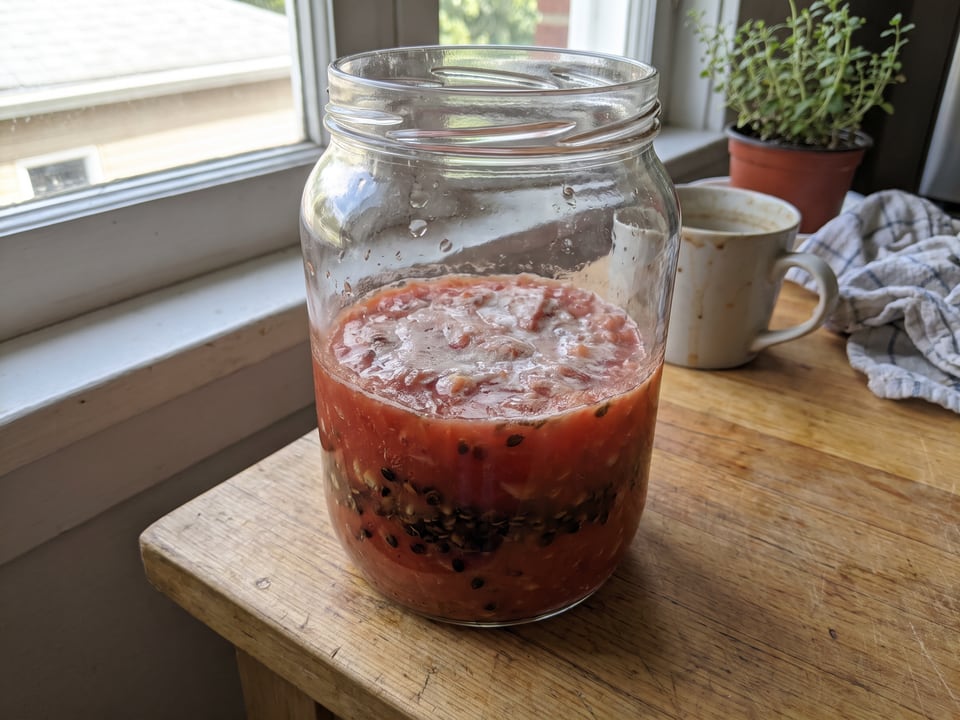
- Within a few days the mixture ferments and the good seed settles at the bottom. Illinois gives two to four days; Minnesota and Vermont say the seeds should sink within five days.
- Add water, stir, and let it settle. Viable seed sinks; pulp and bad seed float, so pour that off. Repeat until what is left is clean seed and clear water.
- Tip into a fine sieve, rinse, and spread the seeds out to dry.
Drying
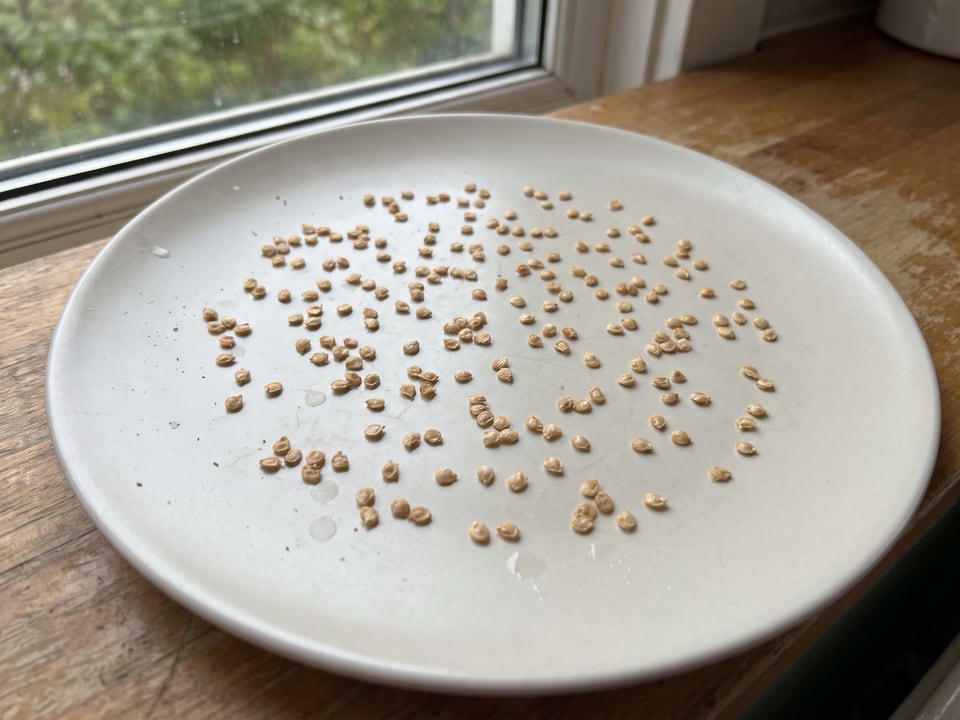
Spread the seeds in a single layer to dry, out of direct sun. The extension sources differ on the surface and agree that it does not matter much: Minnesota and Illinois dry them on paper towels, Illinois also suggests a fine screen, and Vermont lists newspaper, coffee filters, paper plates or a screen.
Storing, and how long it lasts
Paper envelopes inside a sealed glass jar, somewhere cool, dry and dark. Illinois recommends exactly that, and Minnesota puts the ideal temperature at 32 to 41°F (0 to 5°C), which makes the refrigerator a good place for the jar. A small sachet of silica gel in the jar absorbs moisture; Minnesota also suggests a tablespoon or two of fresh powdered milk wrapped in tissue, which works for about six months.
How long the seed lasts depends on whom you ask. Colorado State lists tomato seed at a relative longevity of 4 years, and Iowa State at 3 to 4 years in cool, dry storage. Minnesota is more cautious and says to use saved seed within a year, because germination and vigor drop as seed ages. The safe reading is that a year-old jar is fine and anything older is worth testing before you rely on it.
Label every envelope with the variety and the date you collected it, which Minnesota and Illinois both ask for. Two unlabeled envelopes of small flat cream-colored seed are two mysteries.
Testing what you saved
Before you commit a season to old seed, test it. Iowa State’s method: count out at least 20 seeds (50 is better), spread them on several layers of damp paper towel, roll them up so the seeds stay apart, and keep the roll in a plastic bag somewhere warm, 70 to 80°F (21 to 27°C). Check after two or three days and then daily for a week or so.
Divide the number that sprouted by the number you tested. Iowa State counts 90 percent or better as excellent and says to replace seed at 50 percent or lower with fresh seed. In between, sow more thickly to make up for it.
The sowing calendar picks up from there.
Varieties worth starting with
Any of the 57 heirlooms in the catalog will come true. These carry the fullest sourced histories, which makes them satisfying to keep going:
- Brandywine, the potato-leaf beefsteak listed in the Johnson & Stokes catalogue of 1889
- Cherokee Purple, with a documented Tennessee origin story
- Mortgage Lifter, bred in the 1930s by a radiator repairman in West Virginia
- Black Krim, named for the Crimean peninsula
- San Marzano, the Campanian plum type behind the DOP designation
- Amish Paste, traced to Amish growers in Medford, Wisconsin
- Stupice, Czech, at 55 days one of the earliest in the catalog
Start with two. A jar each, a few days, one evening of rinsing, and you have removed those two lines from next year’s seed order.
Sources
- University of Minnesota Extension, Saving vegetable seeds: tomatoes self-pollinating and easy to save; open-pollinated vs hybrid examples; choosing vigorous plants; fermentation with stirring twice a day, seeds sink within five days, dried on paper towels; storage at 32 to 41°F with silica gel or powdered milk; label and use within a year.
- University of Illinois Extension, How to save seeds: isolation by distance or bagging; tomatoes a few rows apart, 10 to 50 feet recommended (Seed Savers Exchange figures); fermentation for two to four days, stirred daily, breaks down the gel coating; paper towel or screen; paper envelopes in a glass jar.
- University of Vermont Extension, Saving seeds from vegetable crops: self-pollinating flowers, fermentation over five days, drying surfaces, cool dry dark storage.
- Colorado State University Extension, Storing vegetable and flower seeds: tomato seed relative longevity 4 years.
- Iowa State University Extension, Can you use vegetable seeds from last year? (3 to 4 years) and How to store seeds and test germination rates (the germination test and how to read it).