How to dry peppers: air, dehydrator or oven
Sep 27, 2026 · 6 min read
Small thin-walled chiles dry on a string in 3 to 4 weeks. Thick-walled peppers need slicing and a dehydrator at 140°F. Which method suits which pepper, and how to store them.
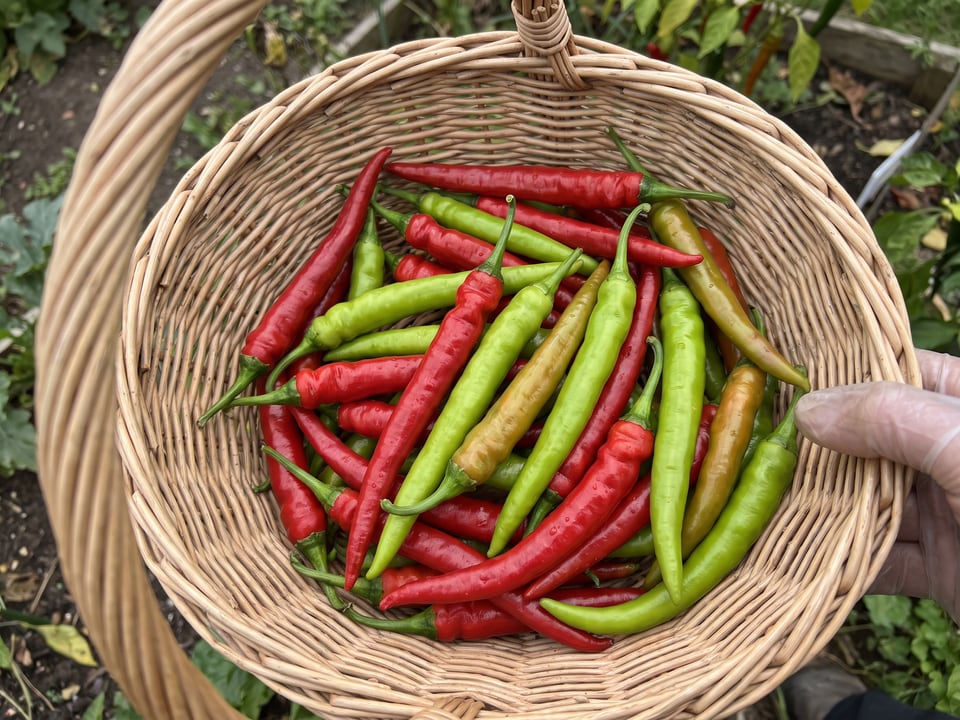
Small, thin-walled hot peppers such as cayenne and chile de arbol dry on a string in a dry, airy room in 3 to 4 weeks. Thick-walled peppers, bells and poblano types among them, do better sliced into strips and dried in a dehydrator at 140°F (60°C), which takes 8 to 24 hours. An oven at its lowest setting does the same job more slowly. Whatever the method, the pepper is dry when it is tough to brittle, and it keeps longest whole, in a sealed jar, somewhere cool and dark.
The right method depends on the pod: how thick its wall is and how big it is. Of the 64 pepper varieties in our catalog, 30 list drying among their uses, and the guide below sorts them by what their pods are like.
Pick them fully ripe
Dry peppers that are fully colored, firm and free of soft spots or mold. New Mexico State University’s ristra guide is blunt about green pods: an immature chile will only shrivel and turn a dull orange as it dries.
Wear gloves when you cut hot peppers. Colorado State University Extension lists food-handling gloves among the equipment for drying them, and capsaicin on bare fingers ends up in eyes.
Air drying on a string
Penn State Extension’s instructions are for small hot peppers: slit each pod with a knife, run a heavy thread through the stems with a large needle, and hang the string in a room where the air circulates freely. It takes 3 to 4 weeks.
Humidity is the limit. Penn State warns that in high humidity the peppers spoil before they finish drying, so in a damp house or a humid late summer the dehydrator below is the safer choice.
The peppers that suit it are small or slender with thin walls:
- Cayenne Long Slim, the pepper most ground cayenne comes from, with thin walls and pods about 19 mm across.
- Chile de Arbol, slender pods about 10 mm wide.
- Tabasco and Chiltepin, both tiny, the second no bigger than a pea.
- Bulgarian Carrot and Lemon Drop, longer pods but thin-walled.
Ristras
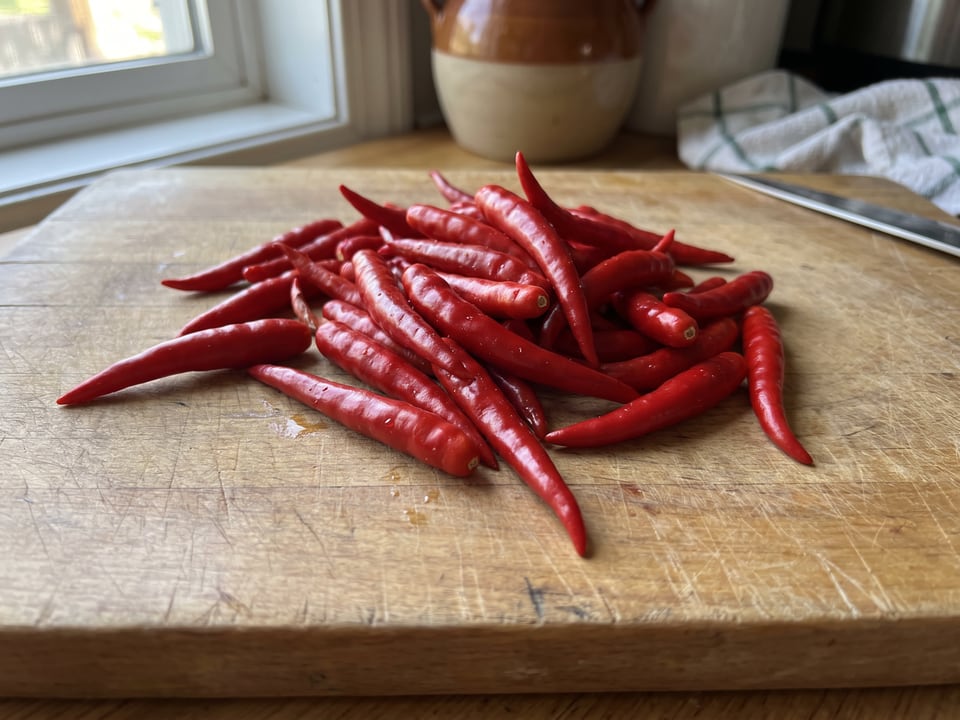
A ristra is the New Mexican version of the same idea: long red chiles tied by the stem into a hanging bundle. NMSU’s guide starts with a 5-foot double strand of heavy twine, ties the stems of three pods at a time between the strands with a half-hitch, and repeats the knot for every cluster. The pods have to be mature, red and pliable with straight stems, and the finished ristra is left to dry in the sun.
The long, thin-skinned chiles grown for red chile sauce are the ones used for it. Chimayo, the northern New Mexico landrace, is sold for exactly this.
One warning from the same guide. Ristras sold as decorations are sometimes sprayed with plastic, shellac or insecticide, and those pods are not food. Only eat from a ristra you tied yourself or one sold for eating.
Dehydrator: the method for thick-walled peppers
The extension instructions for stringing are written for small hot peppers only. For larger and thick-walled peppers, Colorado State and Penn State give the same method instead: stem and core the pepper, remove the seeds and the pale ribs, and cut it into strips or rings 1/4 to 3/8 inch (6 to 10 mm) thick. Lay them in a single layer on the trays.
Colorado State dries hot peppers at 140°F (60°C) for 8 to 12 hours, and chili and pimiento types for 12 to 24 hours. Penn State starts at 140°F for 2 hours and then drops to 130°F (54°C) until done. Turn large pieces every 3 or 4 hours and watch the last hours closely, because thin strips scorch.
Peppers that need this treatment in our catalog include Alma Paprika, a squat, thick-walled paprika type grown to be dried and ground, and the poblano-type Mulato Isleño, whose dried pods are sold as mulato.
Oven drying
An oven works as a dehydrator with worse airflow. Colorado State gives the same 140°F and notes that it may take up to twice as long as a dehydrator.
How to tell they are done, and conditioning
Penn State and Colorado State describe dried peppers as tough to brittle, with no moist spots left.
Colorado State adds one more step, called conditioning. Put the cooled peppers loosely into jars, about two-thirds full, and leave them in a dry place for 4 to 10 days, shaking them daily. If drops form inside the jar, the batch goes back in the dehydrator.
Storing dried peppers
Keep them in sealed jars or bags, labeled with the pepper and the date. Colorado State gives 6 to 12 months for properly stored dried vegetables in a cool, dark place, the refrigerator or the freezer.
NMSU’s research on commercial dried chile found that color loss speeds up as temperature rises, and that ground chile loses color faster than whole pods. So store the pods whole and grind only what you need.
Using dried chiles
Several of the chiles in Mexican cooking are sold under a different name once dried. Guajillo is the dried mirasol. Pasilla Bajio is chilaca when fresh and pasilla when dried. Mulato Isleño dries into mulato.
For a sauce, NMSU soaks large dried pods in boiling water for 30 minutes and then blends them; 12 to 14 large pods give about a pint of purée.
The short version
Small, thin-walled chiles: slit, string, hang in a dry airy room for 3 to 4 weeks. Thick-walled peppers: slice, dehydrate at 140°F for 8 to 24 hours. Oven: same temperature if it goes that low, twice the time. Dry until brittle, condition in jars for 4 to 10 days, store whole in the cool and dark.
The pepper catalog lists pod size and uses for every variety, and the harvest guide covers when each one is ripe enough to pick.
Sources
- Colorado State University Extension, Drying hot peppers and Drying chili and pimiento peppers: gloves, strips 1/4 to 3/8 inch, 140°F, 8 to 12 and 12 to 24 hours, up to twice as long in an oven, tough to brittle, conditioning for 4 to 10 days, 6 to 12 months of storage.
- Penn State Extension, Preserving those colorful garden peppers: stringing small hot peppers, 3 to 4 weeks, spoilage in high humidity, 140°F then 130°F in a dehydrator.
- New Mexico State University, Using chile to make ristras and chile sauce: mature red pods, green chile shriveling to dull orange, tying the ristra, sprayed pods not edible, 12 to 14 pods to a pint of purée.
- New Mexico State University, Postharvest handling of dehydrated chiles: color loss with temperature, ground chile losing color faster than whole pods.