When to pick tomatoes, and how to ripen green ones
Sep 18, 2026 · 8 min read
Harvest tomatoes at the breaker stage, when colour first shows and the fruit gives a little.
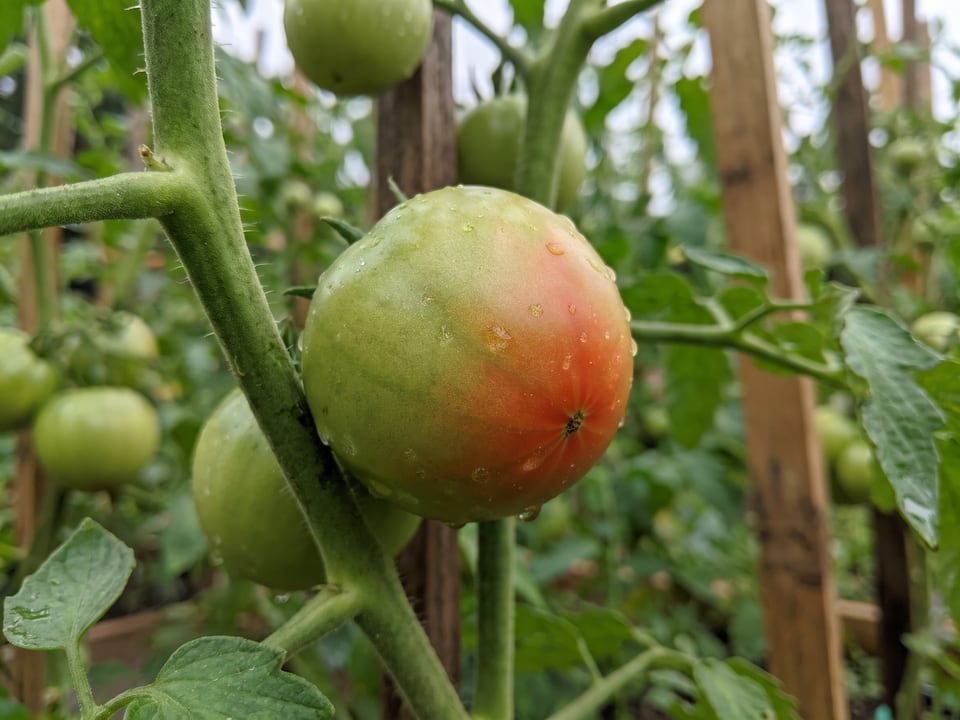
Pick a tomato, or harvest the whole truss, when colour first breaks at the blossom end and the fruit gives slightly under a thumb. That moment is called the breaker stage. Penn State Extension notes that picking at the breaker to pink stage, rather than fully vine-ripe, can reduce cracking.
The same fact is what makes end-of-season green fruit worth carrying indoors instead of composting.
What ripe looks like when the variety is not red
The usual advice, wait until it is fully red, works for about half of what you can grow. In this catalogue, 53 of 132 varieties are red. The rest ripen to pink, black, purple, green, white, orange, yellow, brown, bicolor or striped, and on those the colour rule either misleads you or tells you nothing.
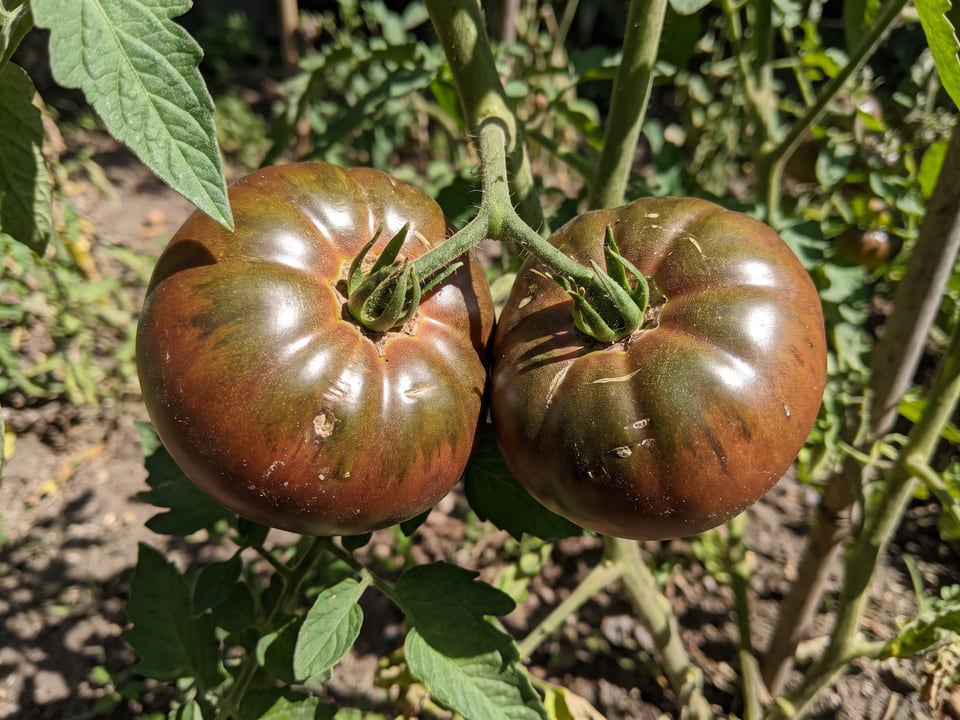
Dark varieties hold green shoulders when the rest of the fruit is ready. On Cherokee Purple and Black Krim, both listed at 80 days to maturity, the shoulders stay dusky green long after the lower two thirds have gone deep. Waiting for an even colour on these means picking a week late. Go by feel instead, and pick when the blossom end yields. The whole group is on the black tomatoes and purple tomatoes pages.
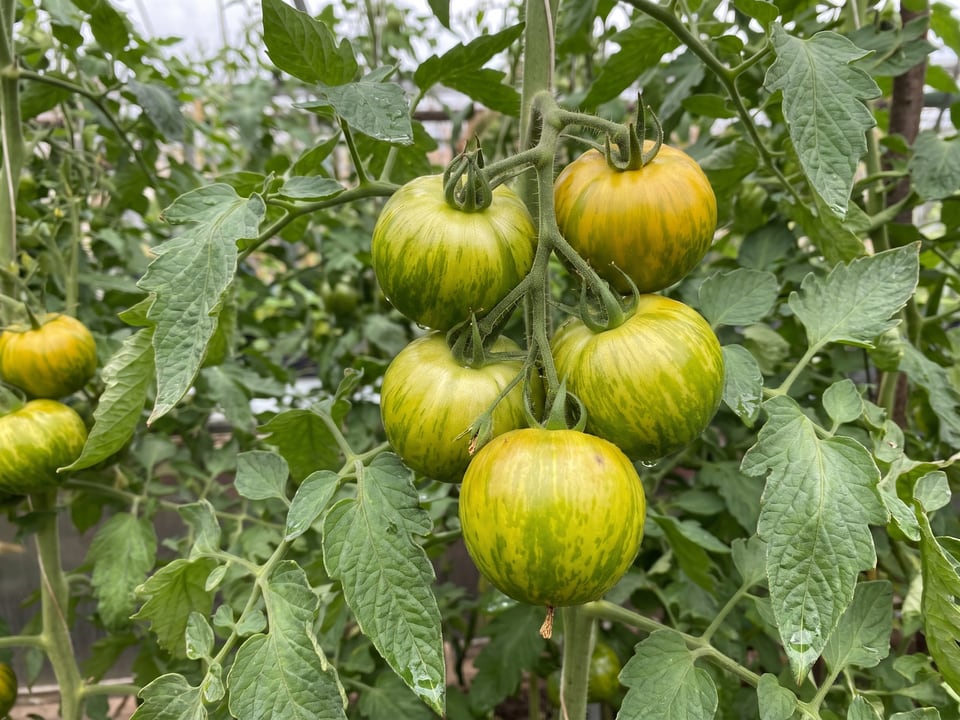
Green-when-ripe varieties are the ones people get most wrong, because there is no colour change to wait for at all. Cherokee Green at 80 days, Aunt Ruby’s German Green at 85 and Green Zebra at 78 are ripe when the skin shifts from matte to faintly translucent, often with a yellow or amber blush at the blossom end, and when the fruit softens. Both beefsteaks in that group are large, with Aunt Ruby’s running 340 to 570 g, so the softening is easy to feel. If you grow these, plant a marker. More of them are lost to being left on the plant than to any pest. The green tomatoes page has the full group.
White varieties such as White Beauty at 85 days go from pale green to ivory, and the change is slight enough that feel decides.
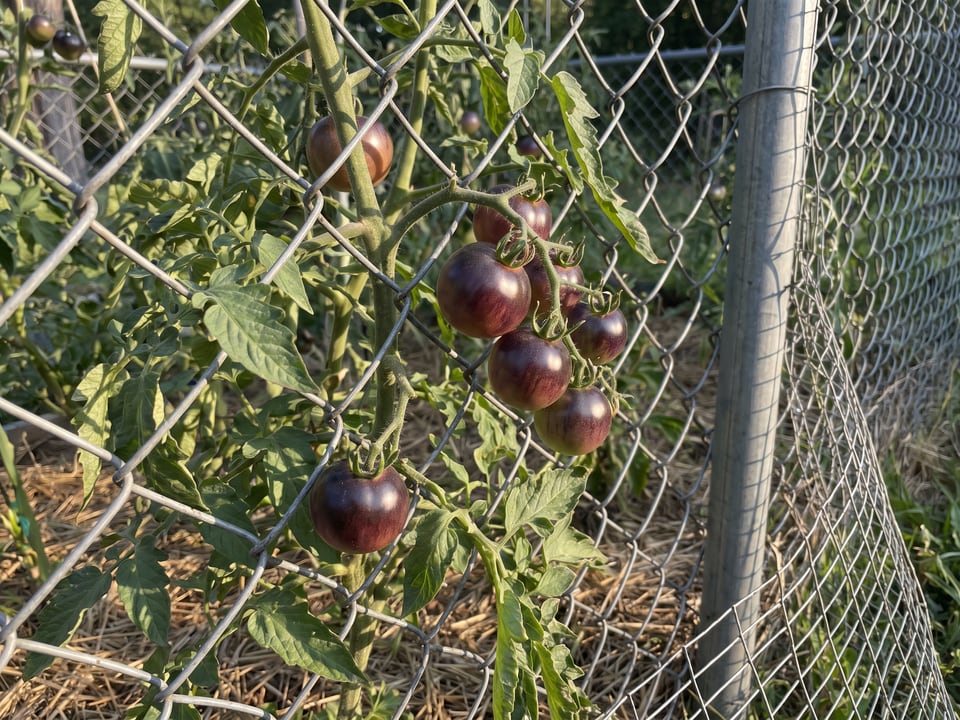
A fourth case is not about ripeness at all. Indigo Rose, at 91 days, develops near-black pigment wherever the sun hits it, long before the fruit is ready. Watch the underside, which turns from green to dull red.
The two tests that work on every variety
Cup the fruit rather than squeezing it. A ready tomato gives a millimetre or two and springs back. A hard one is not ready, and one that dents and stays dented is past.
Then test the stem. Put a thumb on the joint and tilt the fruit upward. If it is ready, the joint separates cleanly with no tearing. If you have to pull, leave it. On varieties that hold their stems stubbornly, snips beat a tug that takes half the truss with it.
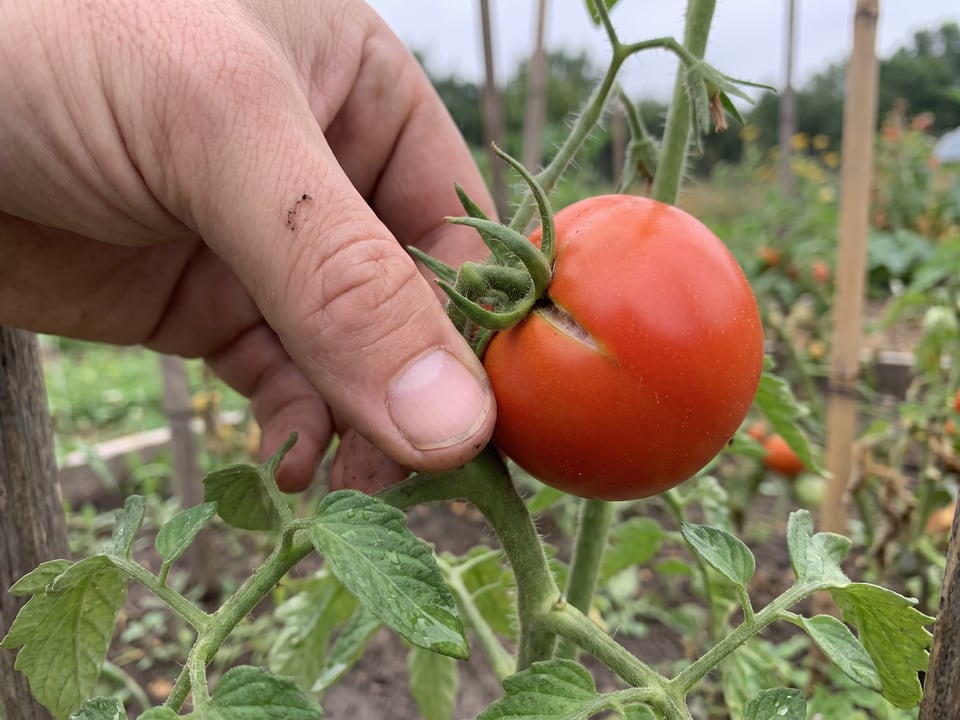
Days-to-maturity numbers, 57 for Sungold and 85 for the bigger beefsteaks, are counted from transplant under good conditions. They tell you roughly which week to start checking, not which day to pick. Use them as a calendar cue, then use your hands.
Picking early on purpose
Four situations make picking before full colour the better call.
Rain is the first. A fruit that has been dry and then takes up a lot of water fast splits at the shoulders; Penn State Extension notes that cracking rises when rain follows a dry spell, and that harvesting at the breaker to pink stage rather than fully ripe reduces it. If the crop is close and heavy rain is forecast, pick anything at breaker stage first. The underlying problem is irregular soil moisture, which is covered in how often to water tomato plants.
Birds and squirrels are the second. They go for the first fruit that shows colour, and picking at breaker removes the target.
The third is load management. On an indeterminate plant, clearing ripe fruit promptly moves the plant’s resources to the trusses above.
Heat is the fourth. University of Arkansas Extension’s advice for hot weather is to harvest fruit at a healthy pink and ripen it further indoors.
Stripping the plant at the end of the season
The threshold that matters in autumn is chilling rather than frost. Clemson’s advice is not to expose unripe tomatoes to anything below 50°F (10°C) at all, and Illinois Extension puts the point where flavour and texture start to deteriorate at 54°F. Illinois Extension notes that bringing chilled tomatoes back to room temperature reverses only some of the damage. Once night temperatures start sitting near that mark the season is effectively over, even if the plants look fine and no frost is forecast for a fortnight.
Go through the plants once and sort what you take. Anything showing colour will ripen on the counter without help. Mature green fruit will also ripen: look for full size for its variety and skin that is light green to whitish, as Clemson describes mature green fruit. Immature green fruit, still small and matte and solid all the way through, will not ripen. It softens and goes off instead. That test costs one tomato.
How to ripen green tomatoes indoors
Warm, dark and enclosed, which rules out the sunny windowsill that most advice recommends.
Put the fruit in a paper bag or a closed box, one layer deep, stem side up, somewhere around 65 to 70°F (18 to 21°C). A ripe tomato in the box speeds it up, Clemson notes, because ripening tomatoes release ethylene. Check every couple of days and take out anything soft or spotted, since one rotting fruit will take the layer with it.
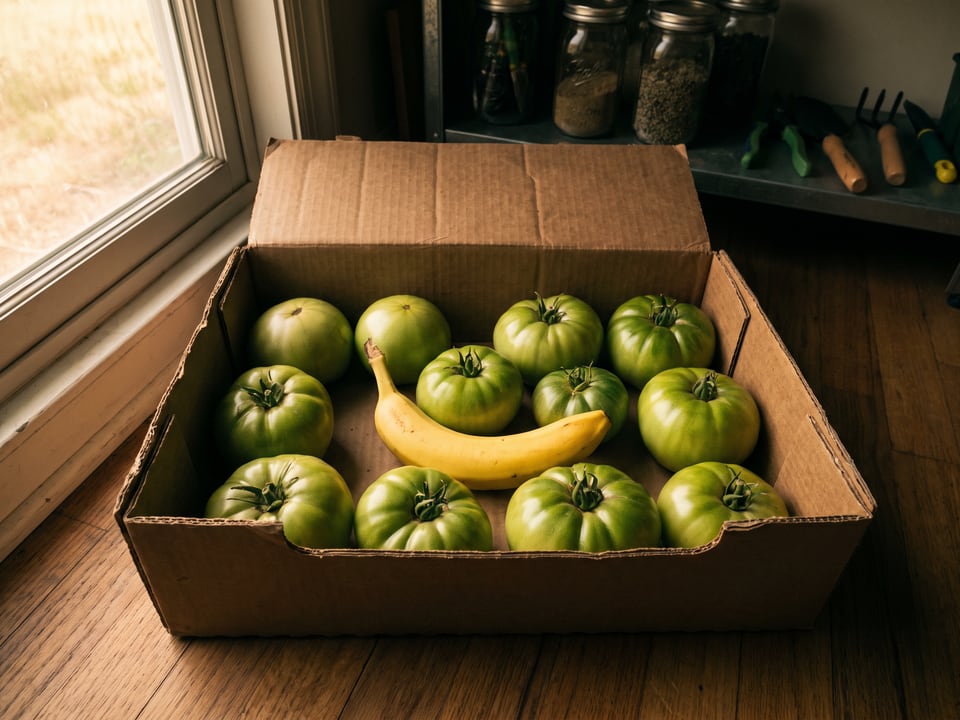
Clemson puts the timing at 14 days for mature green fruit held at 65 to 70°F, and 25 to 28 days at 55°F, so the temperature you pick decides whether you get a rush of ripe fruit or a slow trickle through autumn. Varieties differ too. Long Keeper, at 78 days, is bred to ripen slowly after harvest and to hold for weeks rather than days, which makes it worth a row if your season ends abruptly.
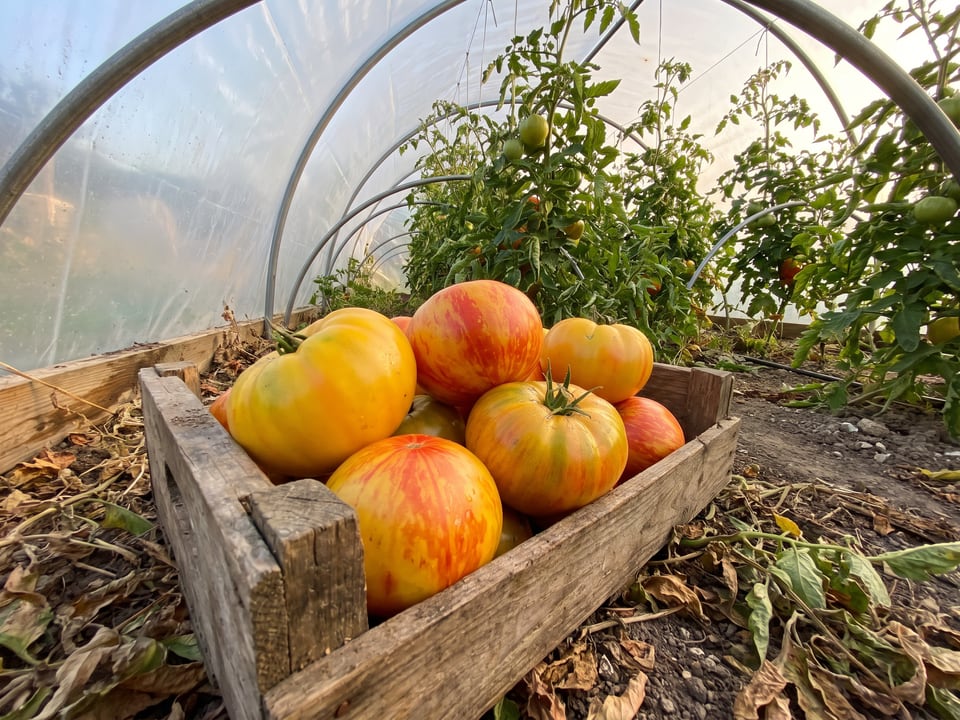
Ripening fruit does not go in the refrigerator. The chilling threshold applies indoors as well, and to ripe fruit too, which is the subject of how to store tomatoes.
One last check before you pull the plants
Look at the leaves before anything goes on the compost heap. Spotted lower foliage or dark lesions on the stems mean the plant may be carrying disease that overwinters in debris, and it belongs in the bin instead. Tomato blight explains how to tell which one you have. If the yellowing is confined to the lower leaves and the plant cropped well, yellow leaves on tomato plants covers the ordinary end-of-season causes.
Sources
- Clemson Cooperative Extension, Using and storing tomatoes: ripening times at 65 to 70°F and at 55°F, and the 50°F limit for unripe fruit.
- University of Minnesota Extension, Harvesting and storing home garden vegetables: storing tomatoes near 55°F and not refrigerating them.
- University of Illinois Extension, Preparing tomatoes: flavour and texture deteriorate below 54°F.
- Penn State Extension, Why are my tomatoes cracking: cracking after rain on dry soil, and harvesting at breaker to pink to reduce it.
- University of Arkansas Cooperative Extension, Tips for growing, harvesting and storing tomatoes: harvesting at pink in hot weather and ripening indoors.