Tomato blight: early, late, and what to do about each
Sep 18, 2026 · 7 min read
Early blight creeps up from the bottom leaves over weeks. Late blight can strip a plant within two weeks. How to tell them apart and what each one needs from you.
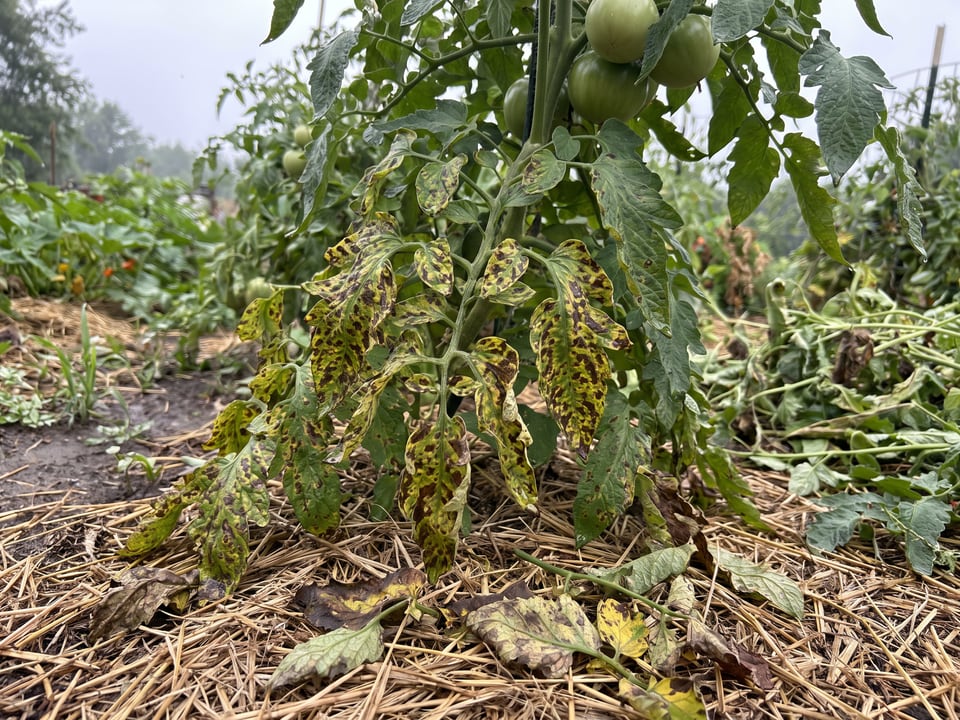
Two different diseases share the name blight, and confusing them costs you either a wasted afternoon or the whole crop. Early blight works slowly from the bottom of the plant upward and you can usually live with it. Late blight moves through a plant in days, spreads to every tomato and potato nearby, and once it has taken hold the only useful action is removal.
Everything else follows from telling them apart.
Early blight
Look for brown spots on the oldest, lowest leaves first. Minnesota Extension describes them as round and brown, growing up to half an inch across, with larger spots showing target-like concentric rings. A yellow halo often surrounds the spot. Affected leaves yellow entirely and drop, and the damage climbs the plant slowly over weeks. On stems it makes dark sunken lesions, and on fruit a dark leathery patch at the stem end.
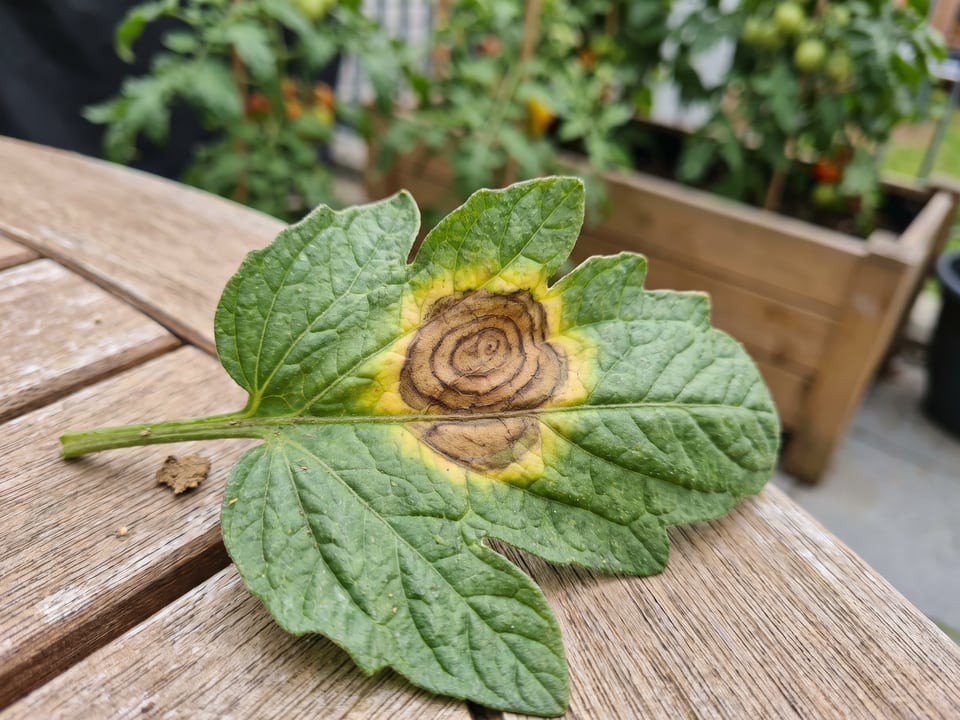
It arrives in warm, humid weather, usually after the plant has set its first fruit, and it is the ordinary background disease of a wet summer. A plant with early blight on its bottom third will still crop, so the urgency is low. The risk is cumulative defoliation, because fewer leaves mean less sugar and more sunscald on exposed fruit.
Take off the affected lower leaves. Minnesota Extension says to bury or burn spotted leaves, or bury them in a home compost pile that is properly maintained, and it puts a limit on how much you take: no more than a third of the plant’s leaves. Mulch, because the spores overwinter in soil debris and reach the plant by rain splash, and a mulch layer physically interrupts that. Water at the base, never over the foliage. Keep air moving through the plant, which is one of the practical reasons for pruning tomato plants. Rotate where you plant tomatoes and potatoes.
Late blight
Look for dark, water-soaked spots that enlarge quickly into greasy, grey-green patches, irregular in shape and often starting at leaf edges or tips rather than as discrete round spots. There are no concentric rings. In humid conditions a white mould appears at the margins of the affected area on the lower leaf surface. Stems develop dark brown to black lesions that can girdle them, and fruit gets greasy brown patches that stay firm at first, though they can turn soft as other organisms invade.
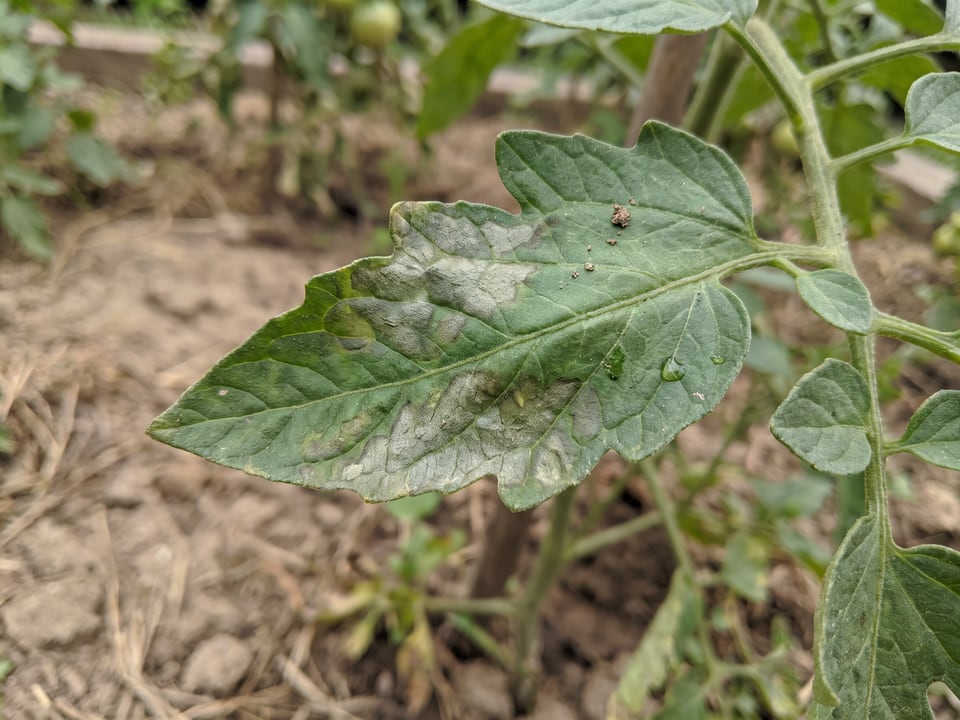
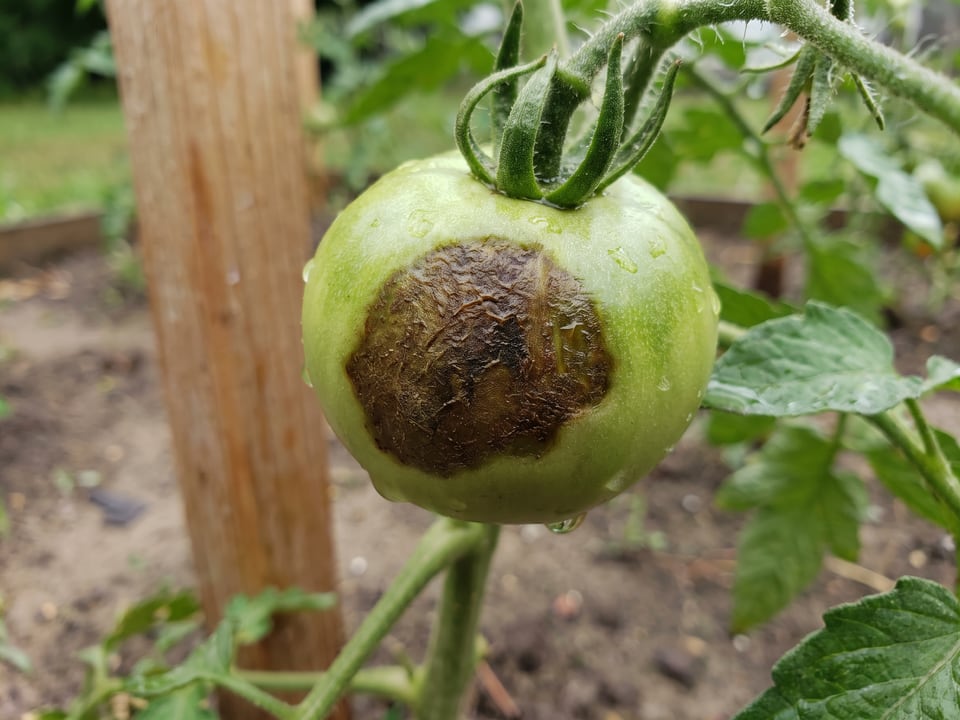
It arrives in cool, wet weather. The University of Minnesota puts the favored range at 60 to 70°F (15 to 21°C), with damp conditions. The spores are airborne and often come from far away, which means a clean garden is no protection.
Penn State says a plant can be largely or completely defoliated within 14 days, and the spores travel to every tomato and potato in the neighbourhood, so this one is urgent, and the handling is stricter than for the leaf spots above. Penn State’s instruction is to cut off affected tissue and bag it daily, preferably on a dry sunny day. Badly affected plants come out whole and go in the rubbish rather than the compost heap, and nothing infected stays lying in the row. If only one plant of several is affected and the weather is due to turn dry, removing that plant may save the rest, though it often does not. Harvest mature fruit from unaffected plants immediately, and check each one before bringing it in, because green fruit carrying infection rots indoors instead of ripening. The mature-green test is in when to pick tomatoes.
Late blight is also the reason not to leave volunteer potatoes in the ground over winter.
The one that gets mistaken for both
Septoria leaf spot produces numerous small circular spots with dark borders and a beige centre, again starting on the older, lower leaves. Penn State notes the detail that settles it: the spots are speckled with small black fruiting bodies. Size and number help too, since septoria gives dozens of tiny spots rather than a few larger targets. Its management is the same as early blight, so mistaking one for the other costs nothing.
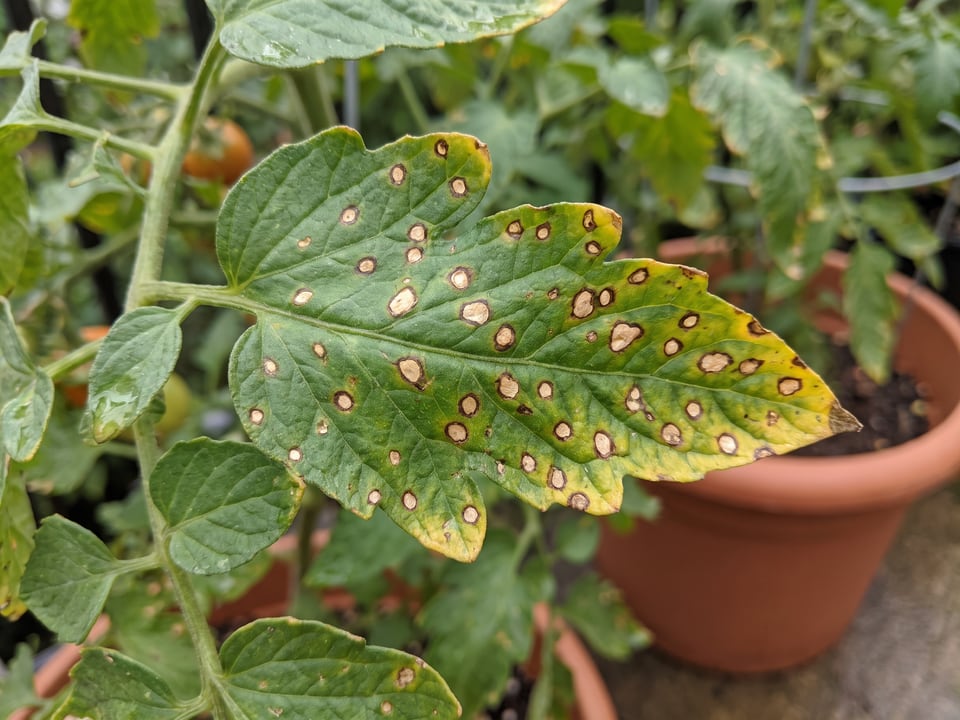
Mistaking any of these for ordinary lower-leaf yellowing does cost something, because that has causes needing the opposite response. If the lower leaves are going yellow evenly with no spotting, start with yellow leaves on tomato plants instead.
Telling them apart at a glance
| Sign | Early blight | Late blight | Septoria |
|---|---|---|---|
| Starts on | Lowest leaves | Any leaves | Lowest leaves |
| Spot shape | Target rings, up to ½ in | Irregular greasy patches | Many small spots |
| Spot colour | Brown, yellow halo | Grey-green, water-soaked | Beige centre, dark rim |
| Underside | Nothing distinctive | White fuzz when humid | Tiny black dots |
| Fruit | Leathery patch at stem end | Firm greasy brown patches | Rarely affected |
| Speed | Weeks | Days | Weeks |
| Weather | Warm and humid | Cool and wet | Warm and wet |
Resistance is the durable answer
Everything above is damage control. The measure that works before the season starts is choosing varieties bred to resist, and it is worth knowing how thin that group actually is.
Of the 132 varieties in this catalogue, four carry late blight resistance and four carry early blight resistance:
- Mountain Magic, 72 days, indeterminate, cocktail. Resistant to both, plus verticillium and fusarium races 1 and 2.
- Plum Regal, 75 days, determinate, plum. Both blights, plus verticillium, fusarium 1 and 2, and tomato spotted wilt.
- Juliet, 60 days, indeterminate, grape. Both blights.
- Purple Zebra, 80 days, indeterminate. Late blight, verticillium, tobacco mosaic, and rated crack tolerant.
- Verona, 67 days, indeterminate, cocktail. Early blight, verticillium.
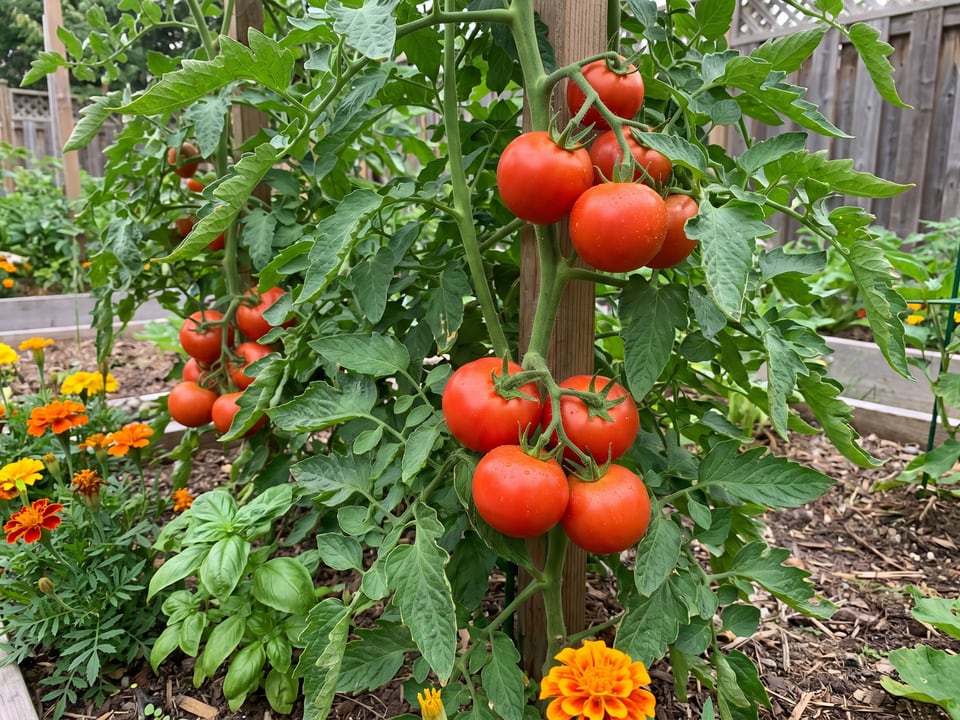
If late blight has hit your garden before, those varieties belong in next year’s plan, and the resistance codes are listed on every variety page in this catalogue so you can check any candidate. Resistance is not immunity: a resistant plant under sustained pressure still shows damage, it simply takes much longer and usually keeps cropping.
Note also what the list does not contain. Almost every heirloom is absent, because these traits came out of modern breeding programmes. That is a real trade-off, and it is the same one set out in what is an heirloom tomato.
Escaping instead of resisting
A second strategy costs nothing and works in cool, wet regions: finish before the weather that brings late blight arrives.
An early variety harvested in July is out of reach of an August outbreak. Glacier and Stupice are both listed at 55 days from transplant, and Oregon Spring at 58. The full group is on the early season tomatoes page.
Growing a few early plants alongside the main crop is cheap insurance, and in a bad blight year they are what you harvest.
Sources
- University of Minnesota Extension, Tomato leaf spot diseases: symptoms of early blight, septoria and late blight, removing the lower leaves, and watering at the base.
- University of Minnesota Extension, Early blight in tomato and potato.
- University of Minnesota Extension, Late blight of tomato and potato.
- Penn State Extension, Tomato-potato late blight in the home garden: cutting off and bagging affected tissue daily, and improving air circulation.
Resistance codes come from the records in this catalogue and are listed on each variety page.