When to plant tomatoes: dates by state and soil temperature
Sep 22, 2026 · 9 min read
Plant tomatoes out once frost has passed and the soil reaches 60°F, usually one to three weeks after the last frost. Safe dates for every state, from NOAA.
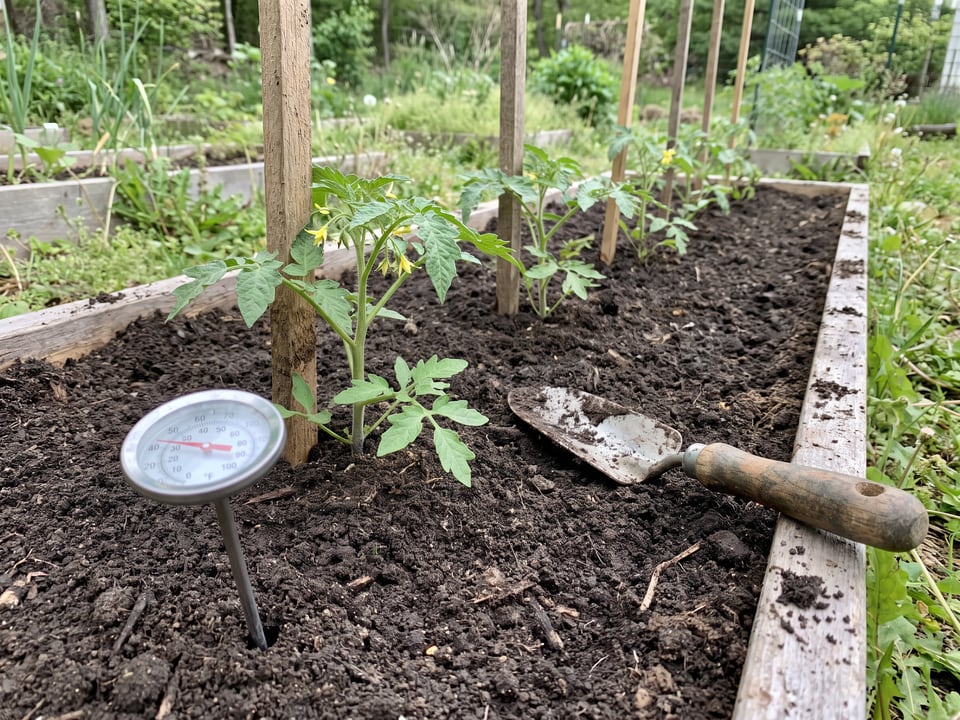
Plant tomatoes outside after your last spring frost, once the soil has warmed to 60°F (16°C). In most of the country that lands one to three weeks after the average last frost date, not on it. A tomato is killed by a single frost, and one set out into cold soil sits still for weeks, so planting early gains you nothing.
Two local numbers set the date: your last frost date and your soil temperature. Below are both, the dates state by state, and how late in the year a planting can still ripen.
The frost date and the soil
The frost date comes first. The average last frost date is the day by which, in half of all years, the last 32°F night has already happened. Half of all years is poor odds for a plant that dies at freezing. A better target is the date by which only one spring in ten still has a frost to come, which is what the table below and our frost date lookup call the safe date. It runs one to three weeks after the average in most places.
Soil temperature is the second test and often the one that decides. Utah State University Extension puts the threshold at soil warmer than 60°F. Set out into colder ground, a transplant survives but does not grow much until the soil catches up. A soil thermometer pushed 4 inches (10 cm) down in the morning answers the question in a minute. Without one, a stretch of nights above 50°F is a fair stand-in, since cold nights are what keep soil cold.
Night temperature matters for another reason. The same Utah State guide notes that when nights fall below 50°F, tomato flowers abort instead of setting fruit. So a plant set out into cold nights can survive and still drop its first flowers.
When to plant tomatoes by state
The table gives the median across NOAA weather stations in each state, from the 1991 to 2020 climate normals. The safe date is the one to plant out on. Treat a state-wide median as a starting point only. In a large state the stations span two months or more, and your own station’s date is one lookup away.
| State | Average last frost | Safe to plant out |
|---|---|---|
| Alabama | Mar 21 | Apr 9 |
| Alaska | May 16 | May 30 |
| Arizona | Mar 29 | Apr 19 |
| Arkansas | Mar 27 | Apr 13 |
| California | Feb 22 | Mar 31 |
| Colorado | May 11 | May 27 |
| Connecticut | Apr 25 | May 9 |
| Delaware | Apr 7 | Apr 21 |
| Florida | Feb 1 | Mar 2 |
| Georgia | Mar 21 | Apr 8 |
| Idaho | May 16 | Jun 4 |
| Illinois | Apr 18 | May 3 |
| Indiana | Apr 21 | May 7 |
| Iowa | Apr 28 | May 11 |
| Kansas | Apr 19 | May 2 |
| Kentucky | Apr 15 | May 3 |
| Louisiana | Mar 1 | Mar 22 |
| Maine | May 8 | May 23 |
| Maryland | Apr 8 | Apr 24 |
| Massachusetts | Apr 27 | May 11 |
| Michigan | May 8 | May 24 |
| Minnesota | May 5 | May 20 |
| Mississippi | Mar 16 | Apr 5 |
| Missouri | Apr 12 | Apr 29 |
| Montana | May 20 | Jun 4 |
| Nebraska | May 2 | May 15 |
| Nevada | May 12 | Jun 2 |
| New Hampshire | May 8 | May 22 |
| New Jersey | Apr 16 | May 3 |
| New Mexico | Apr 29 | May 13 |
| New York | May 4 | May 19 |
| North Carolina | Apr 1 | Apr 17 |
| North Dakota | May 13 | May 27 |
| Ohio | Apr 24 | May 10 |
| Oklahoma | Apr 5 | Apr 22 |
| Oregon | Apr 22 | May 9 |
| Pennsylvania | Apr 28 | May 15 |
| Rhode Island | Apr 22 | May 4 |
| South Carolina | Mar 26 | Apr 10 |
| South Dakota | May 8 | May 21 |
| Tennessee | Apr 7 | Apr 25 |
| Texas | Mar 14 | Apr 4 |
| Utah | May 11 | May 31 |
| Vermont | May 13 | May 28 |
| Virginia | Apr 14 | May 2 |
| Washington | Apr 22 | May 10 |
| West Virginia | Apr 26 | May 14 |
| Wisconsin | May 5 | May 20 |
| Wyoming | May 20 | Jun 4 |
Hawaii has too few stations with complete frost records to give a fair median, and most of it never frosts. Each state name opens the full list of stations for that state, with first fall frost dates alongside.
Why your zone is the wrong number
A USDA hardiness zone is built from the coldest night of an average winter. That tells you which perennials survive the winter. It says little about when spring frosts stop, and tomatoes are annuals that never see the winter. Two gardens in the same zone, one on the coast and one inland, can have last frost dates weeks apart.
Zone planting charts are still everywhere because a zone is easy to remember. If a zone is all you have, our last frost dates by hardiness zone give the median for each half zone with the range around it, and the range is the point: in most zones it spans three weeks or more. Use it as a rough bracket, then check the date for your own ZIP code. The frost date lookup finds the nearest station with thirty years of records.
Planting before the safe date
You can gain a few weeks with protection. Utah State University Extension notes that with plastic mulch and row covers, plants can go out several weeks before the last frost date. The plastic warms the soil and the cover holds a little heat around the plant overnight. Under a cover the plants need ventilating once the air passes 80°F, or the heat under the fabric does its own damage.
Where tomatoes go in twice a year
In Florida and along the Southeast coast, spring planting is only half the calendar, because summer heat also stops fruit set. Utah State gives the upper limit as days above 95°F, when flowers drop. So a second crop goes in during late summer and ripens in the cooler fall.
Florida shows how far the calendar moves. The University of Florida’s Florida Vegetable Gardening Guide gives late March to April and then August for North Florida, January to February and then August to September for Central Florida, and August through February for South Florida. Clemson Extension gives March 1 to April 30 and July 1 to 15 for coastal South Carolina, and recommends no fall crop in the Piedmont. If you garden in these regions, your county extension office’s planting chart is the reference, since the safe spring date only covers the first crop.
How late you can plant tomatoes
Work backwards from the other end of the season. Take your first fall frost date, subtract the days to maturity of the variety. If the answer is still ahead of you, there is time.
Days to maturity is counted from transplanting, so it is the number to use for a plant going in the ground. Early varieties leave the most room. Siletz is listed at 52 days, Glacier and Stupice at 55, Sungold at 57 and Early Girl at 59. Most beefsteaks in the catalog are listed at 75 to 85 days, and one of those needs a long run of warm weather after it goes in. The early-season tomatoes page lists every quick variety in the catalog side by side.
Your first fall frost date comes from the same NOAA stations as the spring one: look it up by ZIP code. The days-to-maturity table sorts the whole catalog from fastest to slowest, so you can see which varieties still fit.
Seeds, transplants and cherry tomatoes
Everything above is about setting out transplants. Tomato seed goes in six to eight weeks earlier, indoors, which is the time Utah State allows to grow transplants, and the guide to starting tomatoes from seed covers that part of the calendar. The planting calculator turns your frost date into sowing and transplant dates for every variety. Sowing seed directly outdoors works only where the season is long, because the plant loses those indoor weeks.
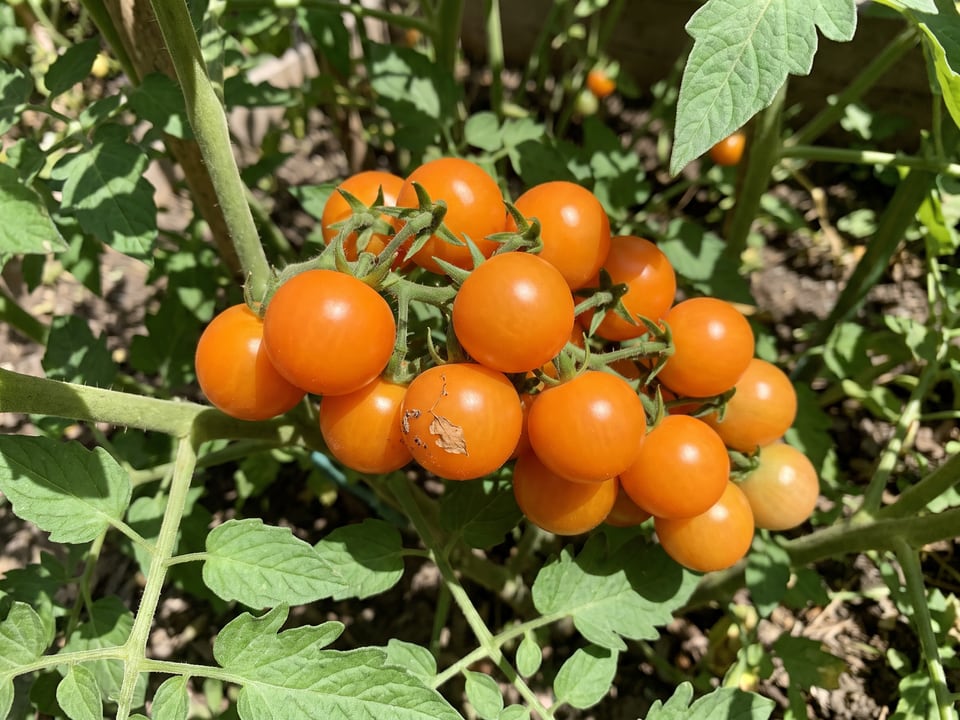
Cherry tomatoes follow the same dates, since the frost and soil thresholds are the same for them. Most of them ripen sooner than the large-fruited types, which makes them the easier choice for a late planting.
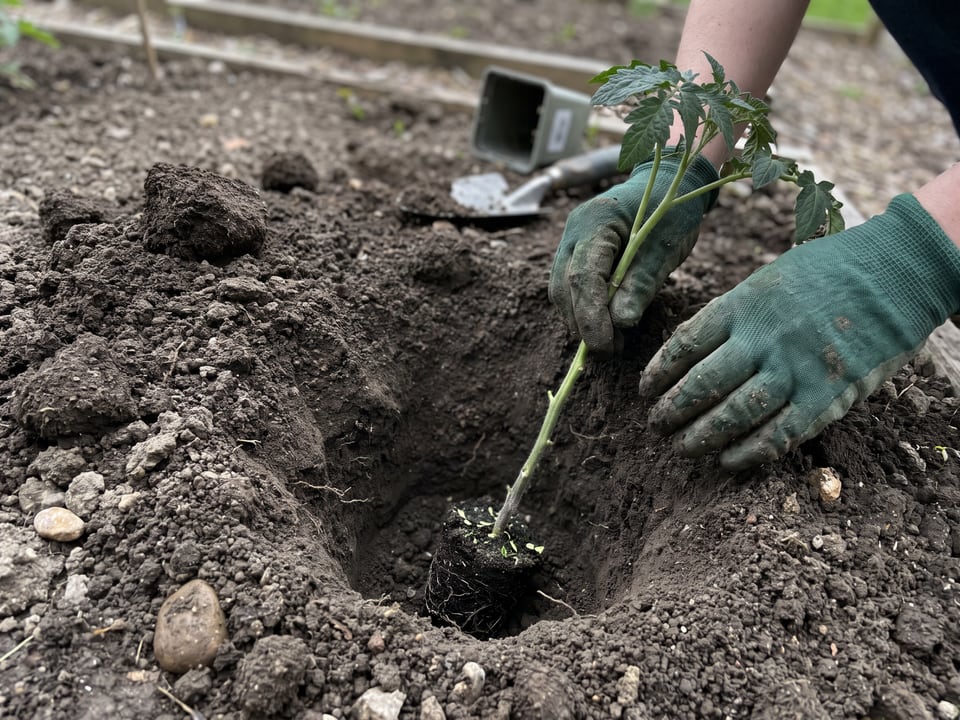
Plant deep when the day comes. Tomatoes root along any buried stem, so a leggy transplant can go in with the lower leaves stripped and two thirds of the stem below ground. Set the stake or cage at the same time, before the roots spread.
Sources
- NOAA National Centers for Environmental Information, U.S. Climate Normals 1991–2020: last spring freeze dates at 32°F by station, the source of the state table.
- Utah State University Extension, How to grow tomatoes in your garden: soil above 60°F, flowers aborting below 50°F at night and above 95°F in the day, and planting weeks earlier under plastic mulch and row covers.
- University of Florida IFAS Extension, Florida Vegetable Gardening Guide: spring and fall tomato planting dates for North, Central and South Florida.
- Clemson Cooperative Extension, Tomato: planting dates for coastal and Piedmont South Carolina.